Japanese cooking: the basics to know
Washoku, umami, the structure of a meal and table manners. Everything to know before cooking or tasting.
Edited by EMA
Checked on: · Source : JAPANITIES editorial team
Washoku, traditional Japanese cuisine
Washoku (和食) means the traditional cuisine of Japan. It has been on UNESCO’s Intangible Cultural Heritage list since 2013. It rests on fresh ingredients, respect for the seasons, simple cooking methods and a balanced meal.
A typical meal: “one soup, three dishes”
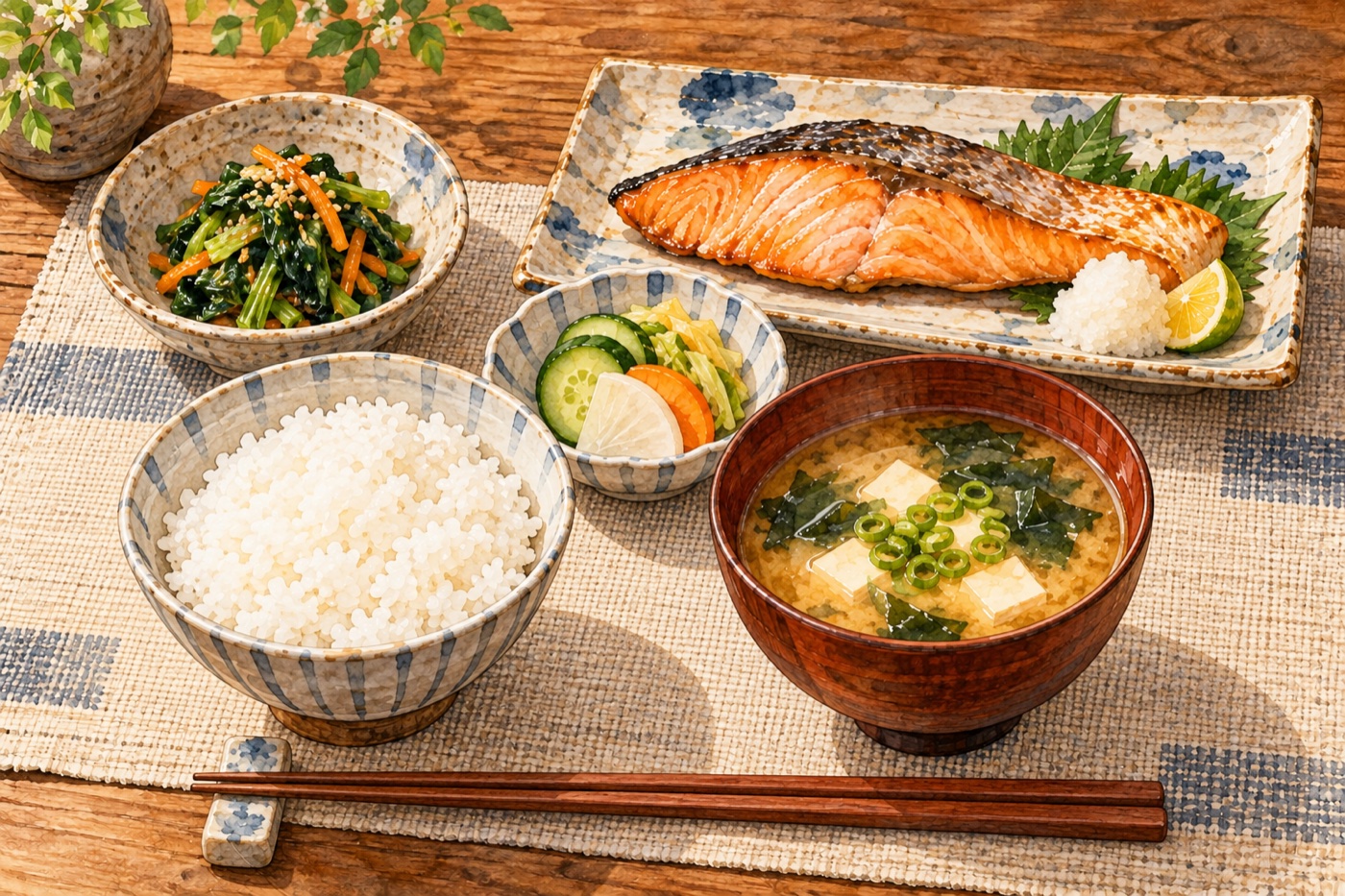
Ichijū-sansai (一汁三菜) is the classic meal structure: rice, a soup, a main dish (fish or meat) and two side dishes (vegetables, tofu, egg), plus pickles.
- Rice is at the centre of the meal. The word “gohan” means both cooked rice and a meal.
- The soup is often a miso soup.
- The small dishes vary with the season.
- In daily life, people often stick to rice, a soup and one dish.
The layout: rice on the left, soup on the right
From the point of view of the person sitting down to eat, the rice bowl goes at the front left and the miso soup at the front right. The main dishes and sides go behind the bowls.
- Chopsticks are placed horizontally in front of the bowls.
- Remember: rice on the left, soup on the right, from where you sit at the table.
| Position | Left | Centre | Right |
|---|---|---|---|
| Back | Side dish (simmered vegetables) | Side dish (seasoned vegetables) | Main dish (fish or meat) |
| Front | Rice | Pickles, if served | Miso soup |
Umami, the fifth taste
Umami (うま味) was identified in Japan in 1908. It is the taste of broth and depth, found in kombu, dried bonito, shiitake mushrooms, soy sauce and miso. Dashi, the basic broth of Japanese cooking, is the best example.
The five basic seasonings: “sa-shi-su-se-so”
The Japanese remember the classic order in which seasonings are added with this mnemonic (さしすせそ).
| Syllable | Seasoning | To remember |
|---|---|---|
| sa (さ) | Sugar (satō) | Goes in first: it penetrates more slowly than salt |
| shi (し) | Salt (shio) | After the sugar |
| su (す) | Vinegar (su) | Added late to keep its aroma |
| se (せ) | Soy sauce (shōyu) | Added near the end: its aroma evaporates |
| so (そ) | Miso | Always last, without boiling it |
Table manners
- Before eating, say “itadakimasu” (“I receive”); at the end, “gochisōsama deshita” (“thank you for the meal”).
- Never stick chopsticks upright in rice: the gesture evokes funeral rites.
- Do not pass food from chopsticks to chopsticks: that too is a funeral gesture. Put it on the other person’s plate.
- Noodles are eaten noisily: slurping is polite and brings out their aroma.
- Lift your bowl of rice or soup to eat, and drink the soup straight from the bowl.
- For sushi, dip the fish (not the rice) in the soy sauce, and do not drown the wasabi in the sauce.
Where to start?
- Make good Japanese rice (see the “Japanese rice” recipe).
- Prepare a miso soup with homemade dashi.
- Build a small stock of basic ingredients (see the “Essential ingredients” guide).
- Try onigiri, tamagoyaki and teriyaki chicken, easy recipes that work well the first time.