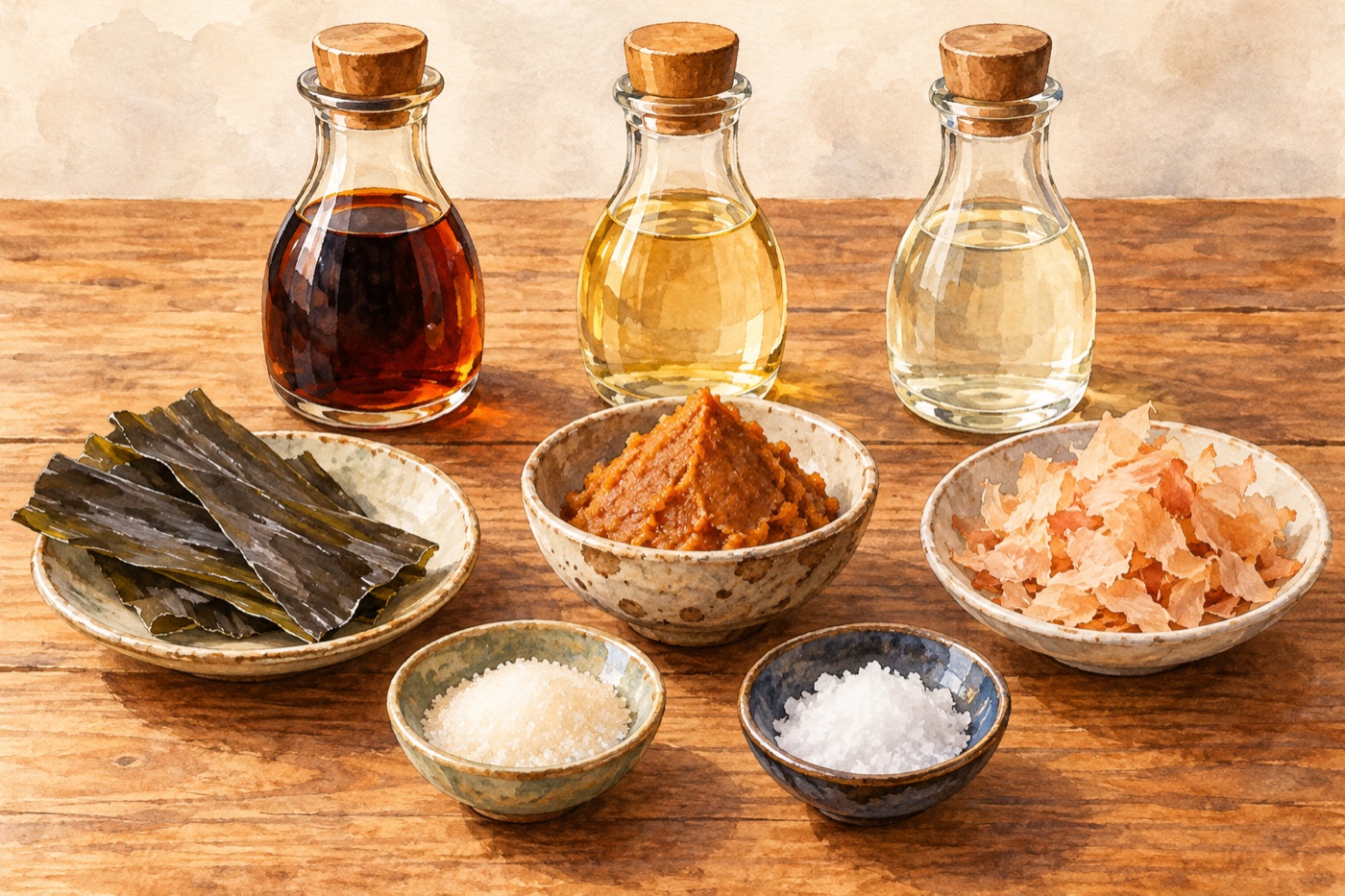
Ingredient guide
Essential ingredients and their equivalents in France
The staples of Japanese cooking, what they are used for, where to find them in France and what to substitute in a pinch.
Edited by EMA
Checked on: · Source : JAPANITIES editorial team
The starter kit: 7 products
With these seven products you can already cook most of the recipes on the site.
- Japanese rice (short-grain or “sushi rice”)
- Japanese soy sauce (shōyu)
- Mirin
- Rice vinegar
- Miso (white, to begin with)
- Instant granulated dashi (“hondashi”) or kombu and katsuobushi
- Nori (toasted seaweed sheets)
The ingredient guide
| Ingredient | What it is | In a pinch |
|---|---|---|
| Shōyu (soy sauce) | A salty, fragrant sauce of fermented soy and wheat. Prefer a “Japanese” soy sauce to Chinese or sweetened soy sauce. | A good-quality light soy sauce |
| Mirin | A sweet rice wine for cooking, used in sauces and glazes. | 1 tbsp sake or dry white wine + ½ tbsp sugar |
| Cooking sake | A rice alcohol that removes odours and adds roundness. | A dry white wine, in small quantity |
| Dashi | A basic broth of kombu seaweed and dried bonito. | Granulated dashi; or a very light vegetable broth |
| Kombu | Dried seaweed that gives umami. Do not boil it. | No exact equivalent: granulated dashi |
| Katsuobushi | Flakes of dried, smoked and fermented bonito. | Granulated dashi |
| Miso | A paste of fermented soybeans. White (shiro): mild; red (aka): strong. | No equivalent: choose a white miso, which is more versatile |
| Japanese rice | Short-grain rice that turns sticky when cooked. | Supermarket short-grain “sushi” rice; avoid basmati and long-grain |
| Rice vinegar | A mild vinegar with low acidity, for sushi and sauces. | A cider vinegar or mild white wine vinegar, in small quantity |
| Nori | Red seaweed, dried and toasted into sheets for onigiri and maki. | None |
| Wakame | Dried brown seaweed that rehydrates in 5 minutes (miso soup, salads). | None; leave out |
| Panko | Japanese breadcrumbs in large flakes, very crunchy (tonkatsu, croquettes). | Coarse breadcrumbs, crumbled by hand |
| Katakuriko | Potato starch for coating (karaage) or thickening. | Potato starch or cornstarch |
| Wasabi | Often a mix of horseradish and mustard in a tube. Real wasabi is rare and expensive. | Grated horseradish |
| Toasted sesame oil | A very fragrant oil used as a finishing touch. | A little neutral oil with toasted sesame seeds |
| Japanese mayonnaise | Milder and richer in egg yolk (Kewpie brand). | Mayonnaise + a little rice vinegar and a pinch of sugar |
| Tofu | Firm or silken soy “cheese”, sold fresh in blocks. | None; available in organic shops |
| Kome kōji (米麹) | Steamed rice on which the kōji mould is grown. A base for miso, amazake and shio kōji. | No exact equivalent. Rice kōji and shio kōji are different. |
| Shio kōji (塩麹) | A fermented seasoning made from rice kōji, salt and water. For marinating meat and fish or seasoning vegetables. | Salt adjusts the taste, but does not reproduce the aromas or the enzymatic action of kōji. |
| Shōyu kōji (醤油麹) | A seasoning made from rice kōji and soy sauce. For sauces rich in umami and seasoned vegetables. | Soy sauce can stand in, with a different result. |
Cooking with kōji
To begin with, a ready-made shio kōji is convenient. The characters 麹 and 糀 are both read “kōji”.
- Rice kōji is a fermentation ingredient; shio kōji and shōyu kōji are seasonings. Check the product name.
- Shio kōji: a marinade for chicken or salmon, a seasoning for vegetables. Follow the quantity and time on the packaging; taste before adding salt.
- Shōyu kōji: a sauce for cold tofu, vegetables or a finishing touch for a stir-fry. Replace part of the soy sauce, starting with a small amount.
- Before grilling food marinated in kōji, remove the excess marinade and watch the heat: the surface can brown quickly.
Finding kōji in France
Look for “koji de riz / kome koji”, “shio koji” or “shoyu koji” at Japanese grocery stores and online. Check availability with the seller.
- Storage conditions differ for dried rice kōji, fresh rice kōji and the ready-made seasoning. Respect the temperature and date shown on the product.
- After opening, follow the storage instructions for shio kōji and shōyu kōji and use a clean spoon. Do not reuse a marinade that has been used for meat or fish.
Where to buy in France
- Supermarkets: soy sauce, nori, short-grain sushi rice, wasabi in a tube, and increasingly miso and mirin in the “world cuisine” aisle.
- Asian grocery stores: the widest choice and best prices, with gyoza wrappers, tofu, panko and curry roux.
- Organic shops: miso, seaweed (kombu, wakame), tofu and good-quality soy sauce.
- Specialist shops and online stores: rarer products, delivered anywhere in France.
Storing the products
- Miso, opened tofu and opened soy sauce: in the fridge.
- Nori and wakame: in an airtight container, away from moisture.
- Mirin and rice vinegar: at room temperature, away from light.
- Cooked rice: eat within the day, or freeze in well-wrapped portions.