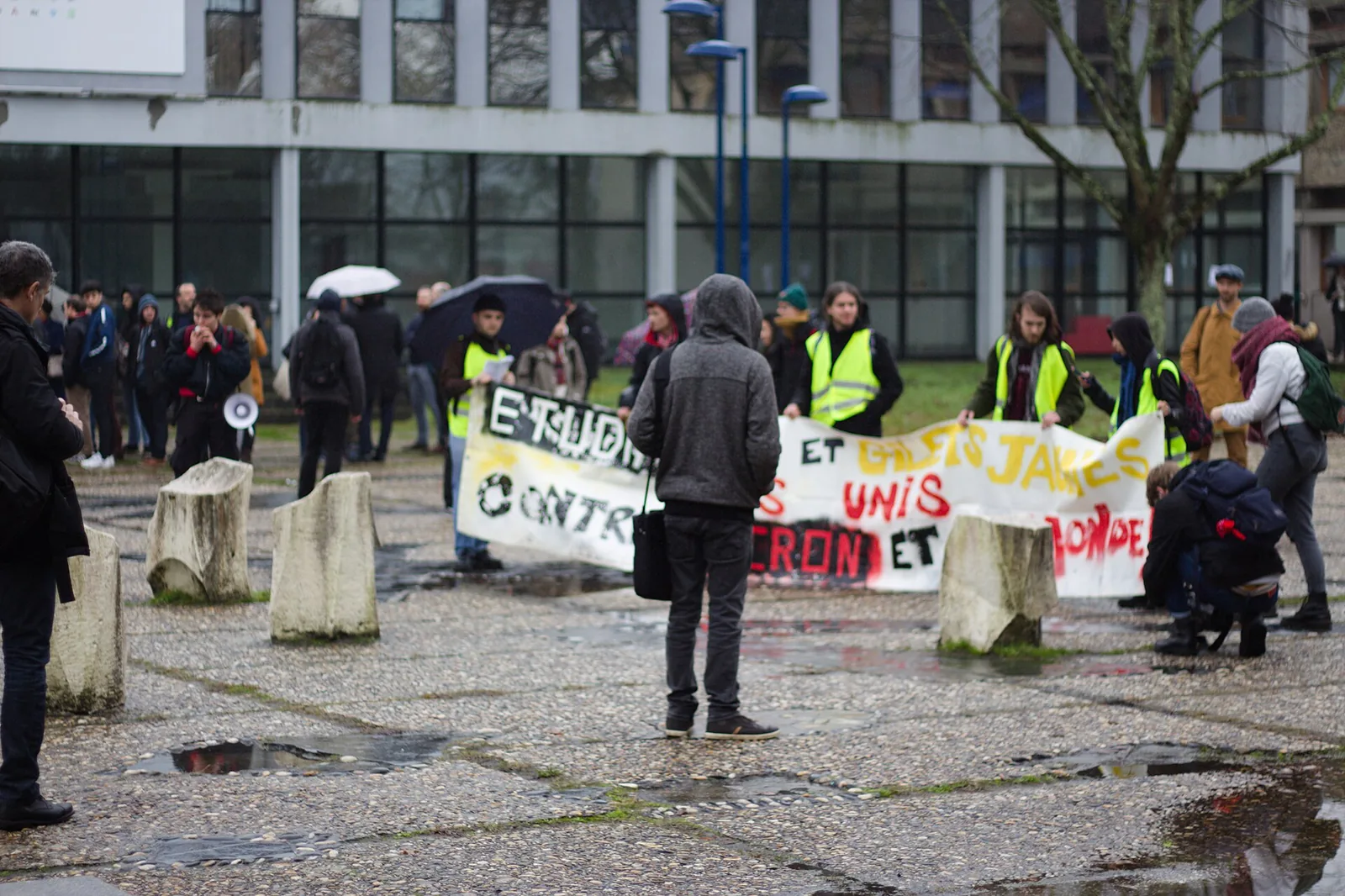
Bordeaux, Saturday 17 October: gathering planned at 2 pm on cours Victor Hugo
Checked on
Published on
Place and time still subject to change. Forecast disruption to trams and buses; detailed route not confirmed.
In this article
When and where?
The gathering is planned for Saturday 17 October from 2 pm, on cours Victor Hugo in Bordeaux. The Métropole states, in its 15 October information, that times and place remain subject to change.
What motive?
An announcement filled in by participants presents this action as a protest against rising fuel prices. This description is not a final administrative confirmation of the organisation.
Transport
The Métropole expects tram stops or interruptions and bus diversions. The sectors cited include Victor Hugo, Pey Berland, Gambetta, Mériadeck, la Bourse, the quays and la Victoire. The exact times by line are not confirmed.
Route and precautions
The detailed route for Saturday is not confirmed. Do not confuse it with Thursday the 15th’s, which appears on the same page. Before leaving, check TBM, allow a margin for your connections and follow the instructions on site.
Learn the grammar
French grammar
Learn sentence patterns and usage from the article’s own sentences.
01The present of être
est / sont + complement
Les horaires précis par ligne ne sont pas confirmés.Key pointsEst is third-person singular and sont third-person plural of être. They express “is / are” — a state or description. If a past participle follows, it is a different structure such as the passive, so check the words that follow.
02The passive voice in the present
être (est / sont) + past participle (+ par / de)
Le rassemblement est envisagé samedi 17 octobre à partir de 14 h, cours Victor Hugo à Bordeaux.Key pointsThe passive means “is done” or “is being done”. It is formed with être + past participle, which agrees with the subject in gender and number (la mesure est adoptée / les mesures sont adoptées). The agent is introduced by par (or de). In the news it is common when the event, rather than the actor, is the focus (est prévu / est annoncé / est connu).
03Negation and its scope
ne / n’ … pas · ne … plus
Cette description ne constitue pas une confirmation administrative définitive de l’organisation.Key pointsNormally ne and pas wrap the verb. Before a vowel, ne becomes n’. Check which part of the sentence the negation covers. Ne … plus means “no longer”.
04Expressing a plan or a deadline
être prévu / prévoir / être envisagé
Le rassemblement est envisagé samedi 17 octobre à partir de 14 h, cours Victor Hugo à Bordeaux.Key pointsPrévoir means “to plan, to expect”. Être prévu means “to be scheduled” and être envisagé means “to be under consideration”. In the news, read them separately from expressions that describe events that have already happened. They do not say that the event has already taken place.
05Dates and their prepositions
le + 日付 / du … au …
La Métropole précise, dans son information du 15 octobre, que les horaires et le lieu restent susceptibles de changer.Key pointsLe 15 octobre means “on 15 October”. Distinguish the le before a date from the le that marks a weekly habit like a weekday. Du is de + le and au is à + le, so decide the meaning from the verb and period expressions around them. Their role depends on the group: a range of dates, the date of a bulletin or another complement.
06Marking a starting point
dès / depuis / à partir de + point in time
Le rassemblement est envisagé samedi 17 octobre à partir de 14 h, cours Victor Hugo à Bordeaux.Key pointsDès means “as early as” or “as soon as”, and à partir de means “from … onwards”. Depuis basically shows a state or period continuing from a point in time. All deal with a start, but they are not used the same way.
07The uses of dans
dans + noun phrase
La Métropole précise, dans son information du 15 octobre, que les horaires et le lieu restent susceptibles de changer.Key pointsDans means “in, inside” for places, but also for a scope such as a system or period. With future time, dans deux jours means “in two days”. In the article’s example, check what it is “inside” and which scope it marks. Identify the value of dans in the passage.
Japanese grammar
Understand the structure and usage from the text.
01Rejecting an interpretation
〜わけではない / 〜という意味ではない
集合の開催条件が行政により最終確定したという意味ではありません。Key pointsThese forms limit and deny an interpretation: “it does not necessarily follow” or “that is not what is meant”. They do not necessarily deny every fact in the sentence. Read what is being denied together with the earlier part.
02Plan, outlook and policy
〜の予定 / 〜見込み / 〜方針
10月17日(土)14時から、ボルドー中心部のCours Victor Hugo(ヴィクトル・ユゴー通り)で集合する見込みです。Key points予定 is a plan, 見込み a forecast and 方針 a course of action or intention. None of them asserts that something has already been carried out. Note the difference from expressions such as “決まりました”.
03Expressing a possibility
〜可能性がある / 〜かもしれない
集合時間・場所は変更の可能性あり。Key pointsThese forms say something may happen. Even when “possibility” is written, it does not mean it will certainly happen. Check whose forecast it is, plus the time and conditions.
04Polite negation and plain form
〜ではありません / 〜ではない
集合の開催条件が行政により最終確定したという意味ではありません。Key pointsThey negate a noun and similar content. “ではありません” is the polite form and “ではない” the plain form. “成立ではありません” shows that it cannot be said to have been concluded.
05Giving examples with など
noun / expression + など
Victor Hugo、Pey Berland、Gambetta、Mériadeck、ブルス広場、河岸、ヴィクトワール広場などが影響を受ける可能性があります。Key points“暴言など” gives “abusive language” as one example. It is not necessarily a closed list of only the things named. It also helps when reading the scope of a news story.
06Quoting with と: content and report
plain-form sentence + と + verbe de parole (報じる, 説明する…)
ボルドー・メトロポールの15日更新の案内は、時間・場所がまだ変更され得るとしています。Key pointsと takes the content that is reported or explained. In “改定する方針だと報じました”, “改定する方針だ” is what the report said. Separating the content from who said it and how makes long sentences easier to read.