Bordeaux, Saturday 24 October: demonstration banned in the city centre, unions appeal, minors’ curfew from 8 pm
Checked on
Published on
The situation on the morning of 24 October on the Bordeaux demonstration: ban in the city centre, unions’ appeal, security arrangements, transport and curfew.
In this article
When and by whom?
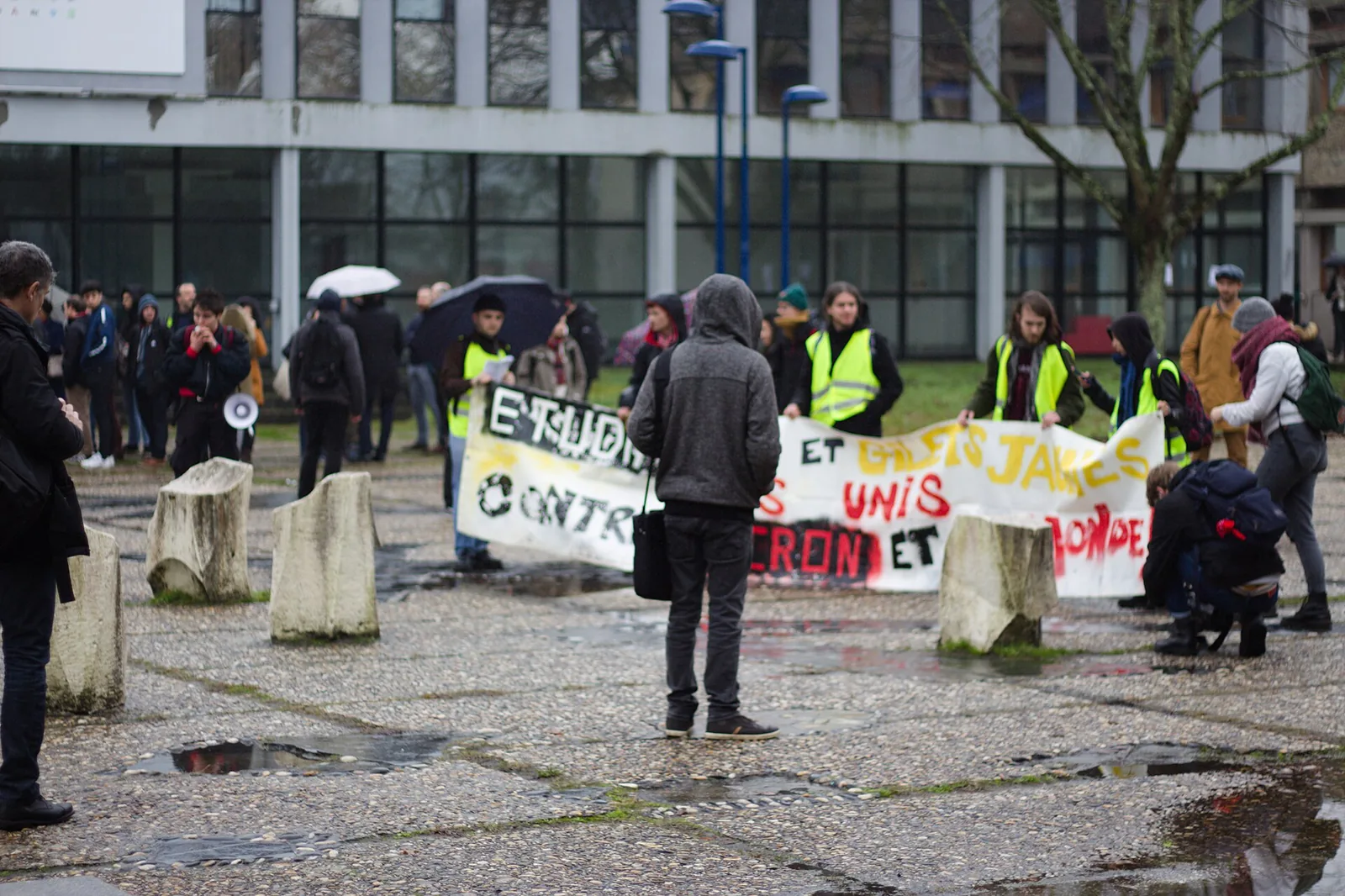
A new mobilisation is announced in Bordeaux on Saturday 24 October. The Coordination nationale des Gilets jaunes calls it “act II”. The Coordination nationale lycéenne also calls for demonstrations on 22 and 24 October. The union day of 5 November is a separate call.
Latest information from the 24th: the demonstration ban in the city centre is in force
The prefect of the Gironde, Sophie Brocas, announced on Friday 23 October a ban on demonstrating in the hyper-centre of Bordeaux, on Saturday and Sunday. The mayor, Thomas Cazenave, also asked for marches to be kept away from the centre, notably rue Sainte-Catherine. According to ICI, the ban zone covers about 7% of the city, on the left bank: from Mériadeck to the Garonne quays, and from the station district to cours de la Martinique, in Chartrons. The prefecture justifies the measure by the wish to prevent peaceful demonstrators from serving as cover for violent elements. Outside the zone, gatherings remain possible, according to France 3.
The unions and the current situation
The march declared by the inter-union group (CGT, FO, FSU), which was to leave at 2 pm from place de la Bourse, is banned for lack of agreement on another route. The CFDT and UNSA have withdrawn their call to demonstrate, according to France 3. As early as Thursday evening, the inter-union group filed an emergency liberty application (référé-liberté) with the administrative court to suspend the ban; the LDH, the SAF, the CGT and the FSU are said to have done the same. In France 3’s live coverage, the court was examining the request; at 11:25 am on 24 October, no decision was reported. The unions doubt the timeframe is enough for an appeal.
Where? (ban zone and security arrangements)
The march planned at 2 pm at place de la Bourse is banned. Bordeaux Métropole mentioned possible gatherings near place de la Bourse and the Stade Atlantique; on the morning of the 24th, neither time nor place was confirmed. On security, according to ICI, police and gendarmerie are reinforced by specialist units (RAID, BRI), armoured vehicles, a water cannon, helicopters and drones. Demonstrators will be searched (weapons, covered faces, dangerous liquids), with checks also at stations and on the roads.
Impact on transport
According to ICI, TBM expects disruption across the whole metropolitan network, with no detail of lines or times on the morning of the 24th. Independently of the mobilisation, tram A is interrupted between Pin Galant and Le Haillan Rostand until 25 October inclusive, with replacement buses.
Curfew for minors
In the city-centre ban perimeter, unaccompanied minors can no longer move around from 8 pm to 7 am, instead of 10 pm, according to ICI and France 3. The end of the measure is not specified in the 24th articles consulted; the previous announcement set it at the morning of 26 October. Rue Sainte-Catherine and rue Porte-Dijeaux, cours de l’Intendance and places Saint-Projet and Général-Sarrail are among those concerned. The measure follows the 17 October demonstration.
Shops and the match
The authorities do not ask for a general closure of the centre and encourage shops able to receive the public to stay open. France 3’s live coverage of the 24th nevertheless reports that some shopkeepers in the centre have barricaded themselves in. According to the CCI, 81 shops were affected on 17 October, with €8–10 million of estimated damage (update of 20 October). The Girondins–Stade Montois match is postponed from Saturday 24 to Sunday 25 October at 3 pm at the Stade Atlantique; tickets already bought remain valid.
If you go out
If you go to the centre on Saturday, allow some margin. Tram and bus information is on the TBM website or on 05 57 57 88 88; also see the travel pages of Bordeaux Métropole. Check again the same morning, once places and times are known.
The new national instruction (announced on the evening of the 22nd)
On the evening of 22 October, Emmanuel Macron announced that, for the demonstrations of Saturday 24, only marches declared and organised by unions would be authorised, the others being banned “wherever we can”. Demonstrations are banned in Le Havre, Lyon and Marseille, among others. The fate of the gatherings of the 24th in Bordeaux was not confirmed at the date of this article; check the latest announcements from the prefecture and Bordeaux Métropole. More details in the 23 October article on French news.
To keep in mind
Information as of about 11:25 am on 24 October. The court’s decision, any gatherings and the length of the curfew may change. Check the latest announcements from the prefecture, Bordeaux Métropole and TBM.
Learn the grammar
French grammar
Learn sentence patterns and usage from the article’s own sentences.
01The present indicative
est / sont + attribute (noun, adjective, prepositional phrase)
La journée syndicale du 5 novembre est un appel distinct.Key pointsÊtre in the present is est for a singular subject and sont for a plural one. It describes nature, state or place (“is”, “is located”). If what follows (the attribute) is a noun, adjective or prepositional phrase, it is not a passive. If a past participle follows, it is a passive (est annoncé). Headlines and summaries often use the present to describe the current situation.
02The passé composé
present of avoir + past participle
La préfète de la Gironde, Sophie Brocas, a annoncé le vendredi 23 octobre l’interdiction de manifester dans l’hypercentre de Bordeaux, le samedi et le dimanche.Key pointsThe passé composé is the most common past tense, used for “did” and “has done” — actions completed in the past. It is formed with the auxiliary avoir (a / ont…) in the present + a past participle. Past participles of -er verbs end in -é (annoncer → annoncé); learn the irregular ones (faire → fait, prendre → pris, voir → vu). In the negative, ne … pas wraps the auxiliary (n’a pas annoncé). In the news it reports facts that have already happened, such as “announced” or “voted”.
03The passé composé of pronominal verbs
se + present of être + past participle
Le direct de France 3 du 24 signale toutefois que des commerçants du centre se sont barricadés.Key pointsThe passé composé of a pronominal verb (se + verb) always uses être as auxiliary (il s’est diffusé / elles se sont réunies). Se changes with the subject: me, te, se, nous, vous. The past participle usually agrees with the subject in gender and number.
04The imparfait
stem (nous form of the present) + -ais / -ait / -ions / -iez / -aient
Le maire, Thomas Cazenave, demandait lui aussi que les cortèges soient tenus à l’écart du centre, notamment de la rue Sainte-Catherine.Key pointsThe imparfait describes states, background, habits and actions in progress in the past (il était, elle avait, ils pensaient). Take the nous form of the present, drop -ons, and add -ais / -ais / -ait / -ions / -iez / -aient. If the passé composé gives “the event itself”, the imparfait paints “the situation at the time”.
05The futur simple
stem (infinitive) + -ai / -as / -a / -ons / -ez / -ont
Les manifestants seront contrôlés (armes, visages dissimulés, liquides dangereux), avec des contrôles aussi dans les gares et sur les routes.Key pointsThe futur simple means “will do” or “is planned to”. Add -ai, -as, -a, -ons, -ez, -ont to the infinitive (participer → il participera). Watch the irregular stems: être → ser-, avoir → aur-, aller → ir-, faire → fer-, pouvoir → pourr-, voir → verr-. In the news it is used for fixed plans and outlooks.
06The present conditional
stem (infinitive) + -ais / -ait / -ions / -iez / -aient
Dès jeudi soir, l’intersyndicale a déposé un référé-liberté devant le tribunal administratif pour suspendre l’interdiction ; la LDH, le SAF, la CGT et la FSU auraient fait de même.Key pointsThe conditional expresses possibility, supposition, unconfirmed information and polite requests (“would”, “might”). It uses the same stem as the future and the same endings as the imparfait (-ais, -ait, -ions, -iez, -aient): pouvoir → il pourrait. In the news it is used to avoid asserting, as in “is reported to…” or “there is a possibility…”.
07The present subjunctive
il faut que / pour que / bien que + subject + subjunctive
Les syndicats indiquent que l’arrêté n’a ni date de début ni date de fin et que la préfète aurait répondu qu’il durerait « jusqu’à ce que ça s’apaise ».Key pointsThe subjunctive expresses wish, need, purpose, doubt and feeling rather than “fact”. It is used inside a clause with que. Triggers: il faut que (must), pour que / afin que (so that), bien que / quoique (although), avant que (before), souhaiter que, vouloir que and others. Formation: stem of the ils present minus -ent + -e, -es, -e, -ions, -iez, -ent. Irregular: être → soit, avoir → ait, aller → aille, faire → fasse, pouvoir → puisse, savoir → sache.
08The passive voice in the present
être (est / sont) + past participle (+ par / de)
Une nouvelle mobilisation est annoncée à Bordeaux le samedi 24 octobre.Key pointsThe passive means “is done” or “is being done”. It is formed with être + past participle, which agrees with the subject in gender and number (la mesure est adoptée / les mesures sont adoptées). The agent is introduced by par (or de). In the news it is common when the event, rather than the actor, is the focus (est prévu / est annoncé / est connu).
09The passive in the passé composé
a / ont été + past participle
Selon la CCI, 81 commerces ont été touchés le 17 octobre, pour 8 à 10 millions d’euros de dégâts estimés (point du 20 octobre).Key pointsThe past passive means “was done”. Its form is present of avoir + été (past participle of être) + past participle. Été does not change, but the last participle agrees with the subject in gender and number (la loi a été votée / les textes ont été votés). It is frequent in news reporting results such as votes, decisions and announcements.
10The imperative
present vous form (-ez) / nous (-ons) / tu
Les informations tram et bus sont sur le site de TBM ou au 05 57 57 88 88 ; consultez aussi les pages déplacements de Bordeaux Métropole.Key pointsThe imperative expresses commands, requests and advice. It has no subject: the sentence starts with the verb (Consultez les informations.). The vous form ends in -ez, nous in -ons (Restons prudents.), and tu in -e for -er verbs (Consulte). It is very common in notices and warnings (Vérifiez, Consultez, Restez informé).
11Negation and its scope
ne / n’ … pas · ne … plus
Selon Bordeaux Métropole, des rassemblements sont annoncés vers la place de la Bourse et le Stade Atlantique ; horaires et lieux définitifs ne sont pas connus.Key pointsNormally ne and pas wrap the verb. Before a vowel, ne becomes n’. Check which part of the sentence the negation covers. Ne … plus means “no longer”.
12Citing a source with selon
selon + noun / organisation
Selon TBM, des arrêts momentanés des trams en station, voire des interruptions sur certains tronçons du centre, sont possibles, ainsi que des déviations de bus ; aucune liste définitive de lignes ou d’horaires.Key pointsSelon means “according to”. Put a person or organisation after it as the source. It separates facts the writer checked directly from what another body or report said. Citing a source does not turn a forecast into an accomplished fact.
13Pouvoir: ability and possibility
peut / peuvent / pourrait + infinitive
Les mineurs non accompagnés ne peuvent pas circuler de 22 h à 7 h dans des secteurs délimités du centre, jusqu’au 26 octobre au matin : rues Sainte-Catherine et Porte-Dijeaux, cours de l’Intendance, places Saint-Projet et Général-Sarrail, notamment.Key pointsPut a base-form verb after pouvoir. Peut means “can” or “may”; the conditional pourrait gives a more reserved possibility, “might”. It does not necessarily mean implementation is settled.
14The subject relative pronoun qui
noun + qui + verb
La préfecture souhaite discuter avec les organisateurs d’un tracé qui préserve l’hypercentre commerçant.Key pointsQui continues a description of the person or thing just mentioned (“the one that does…”). Because qui is itself the subject of the next verb, do not repeat the subject. The verb agrees with the noun qui refers to.
15Dates and their prepositions
le + 日付 / du … au …
La journée syndicale du 5 novembre est un appel distinct.Key pointsLe 15 octobre means “on 15 October”. Distinguish the le before a date from the le that marks a weekly habit like a weekday. Du is de + le and au is à + le, so decide the meaning from the verb and period expressions around them. Their role depends on the group: a range of dates, the date of a bulletin or another complement.
Japanese grammar
Understand the structure and usage from the text.
01Citing a source: によると
noun + によると
ボルドー・メトロポールによると、ブルス広場とスタッド・アトランティックの近くで集会が予定されています。Key pointsAs in “LCPによると”, it shows where the information comes from. What that source reported follows. It is used differently from “私にとって”, which gives one’s own opinion.
02Expressing a possibility
〜可能性がある / 〜かもしれない
TBMによると、トラムは駅で一時的に止まるか、中心部の一部で運休する可能性があります。Key pointsThese forms say something may happen. Even when “possibility” is written, it does not mean it will certainly happen. Check whose forecast it is, plus the time and conditions.
03Giving examples with など
noun / expression + など
対象は、サント・カトリーヌ通りとポルト・ディジョー通り、アンタンダンス大通り、サン・プロジェ広場、ジェネラル・サラル広場の周りなどです。Key points“暴言など” gives “abusive language” as one example. It is not necessarily a closed list of only the things named. It also helps when reading the scope of a news story.
04The polite past ました
verb stem (連用形) + ました
17日のデモのあとに決まりました。Key pointsIn “発表しました”, ました makes a verb polite past. The negative is “ませんでした”. Read the actual date together with the date and time in the text.
05Possibility in Japanese: できる・られる
verb potential form / 〜ことができる
トラムとバスの最新の情報は、TBMのサイトか電話(05 57 57 88 88)で確認できます。Key pointsできる is the basic verb for ability. The potential form of 受ける is 受けられる. The same られる can also be passive or honorific, so decide from the meaning of the sentence.
06Linking actions with the て-form
verb て-form + next expression
高校生の調整団体も、22日と24日にデモを呼びかけています。Key pointsThe て-form links actions in a series, in order or as a reason. In “確認して、出発する” the relation is judged from the content. In “〜ている” it can show an action in progress or a continuing state.