Oborozukiyo: lyrics, background and Japanese vocabulary
Checked on
Published on
Discover a song evoking the gentleness of a spring night: video, lyrics with furigana, an English translation and explanations of the old words.
In this article
Video: listen and discover
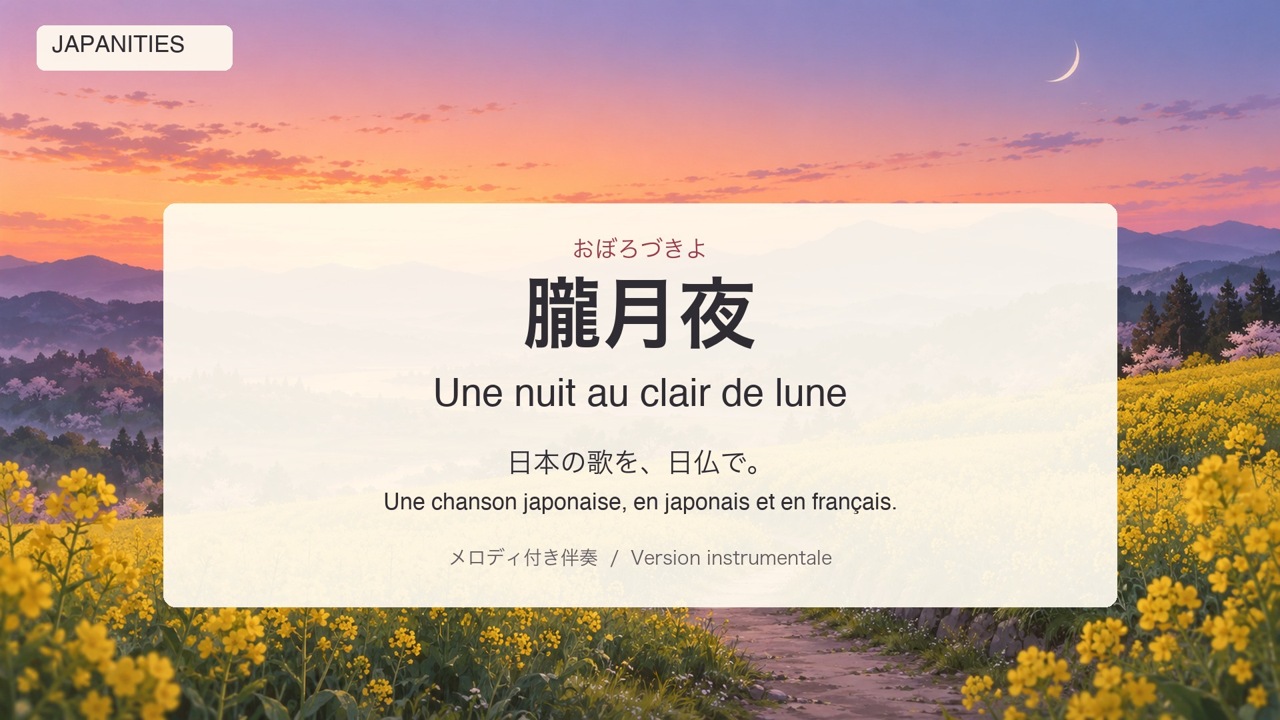
Discover “Oborozukiyo” with the lyrics, furigana and a translation. This JAPANITIES video lasts about 1 min 44: instrumental accompaniment with melody, no sung vocals.
Background: what is this song?
“Oborozukiyo” is a Japanese school song published in 1914 in a collection for the sixth year of primary school. The lyrics are by Tatsuyuki Takano and the music by Teiichi Okano. The song evokes the countryside as evening turns to night, in spring. The first verse shows rapeseed fields, mountains, the sky and the moon. The second turns to the village lights, passers-by and the sounds of frogs and a bell.
The title: a night of the veiled moon
“Oboro” expresses a blurred, indistinct outline. “Oborozuki” means a veiled moon, notably by spring haze; “oborozukiyo” is a night lit by this moon. Imagine a soft light enveloping the landscape, rather than a dazzling full moon in a perfectly clear sky.
Lyrics: first verse
Some spellings have been modernised to make reading easier. JAPANITIES’ original translation helps you understand the text; it is not meant to be sung.
- Over the rapeseed fields, the light of the setting sun fades.
- Far away, the mountain ridges are veiled in thick haze.
- When I look at the sky where the spring wind blows softly,
- the evening moon hangs there, in a delicate clarity.
Understanding the first verse
“Irihi usure” describes the light of the setting sun growing faint. “Yama no ha” is the line of ridges at the edge of the sky. “Kasumi fukashi” evokes a thick haze that blurs the distance. “Soyofuku” means to blow gently. “Yūzuki kakarite” says that the evening moon hangs in the sky. Here, “nioi” is understood in its old sense of visible beauty, colour or radiance, rather than as a smell.
Lyrics: second verse
The lights, silhouettes and sounds of country life come together.
- The glimmers of the village and the colours of the forest,
- the passers-by following the little path among the rice fields,
- the song of the frogs and the sound of the bell:
- everything seems bathed in haze, on this night of the veiled moon.
Understanding the second verse
“Sato wa” means the surroundings of the village, and “hokage” a glow of fire or lamp. “Tanaka” here means “in the middle of the rice fields”: it is not a family name. “Kawazu” is an old word for frog. “Naku ne” means the cry of this animal, and “kane no oto” the sound of a bell. Here, “sanagara” suggests that the whole landscape is wrapped in haze. The repetition of “mo” gathers lights, people and sounds into one scene. Describing even the sounds as veiled creates a poetic effect.
Language: recognising old forms
“Fukashi” and “awashi” are old conclusive forms, corresponding to “fukai” and “awai” in modern Japanese. In “kakarite”, the particle “te” links the clause to what follows. In this landscape, “mireba” is naturally understood as “when I look”. “Kasumeru” here is not a modern potential: it combines a form of “kasumu” with “ru”, the attributive form of the classical auxiliary “ri”, which can express a resulting or continuing state. The meaning is “that is veiled in haze”.
Going further: imagining the landscape
Listen to the melody first, then read the lyrics slowly. Look for what you can see in the first verse and what you can hear in the second. Tap the underlined words to find out what they mean; you can save the words to review in your favourites.