Hera tells two asteroids apart: a step towards studying planetary defence
Checked on
Published on
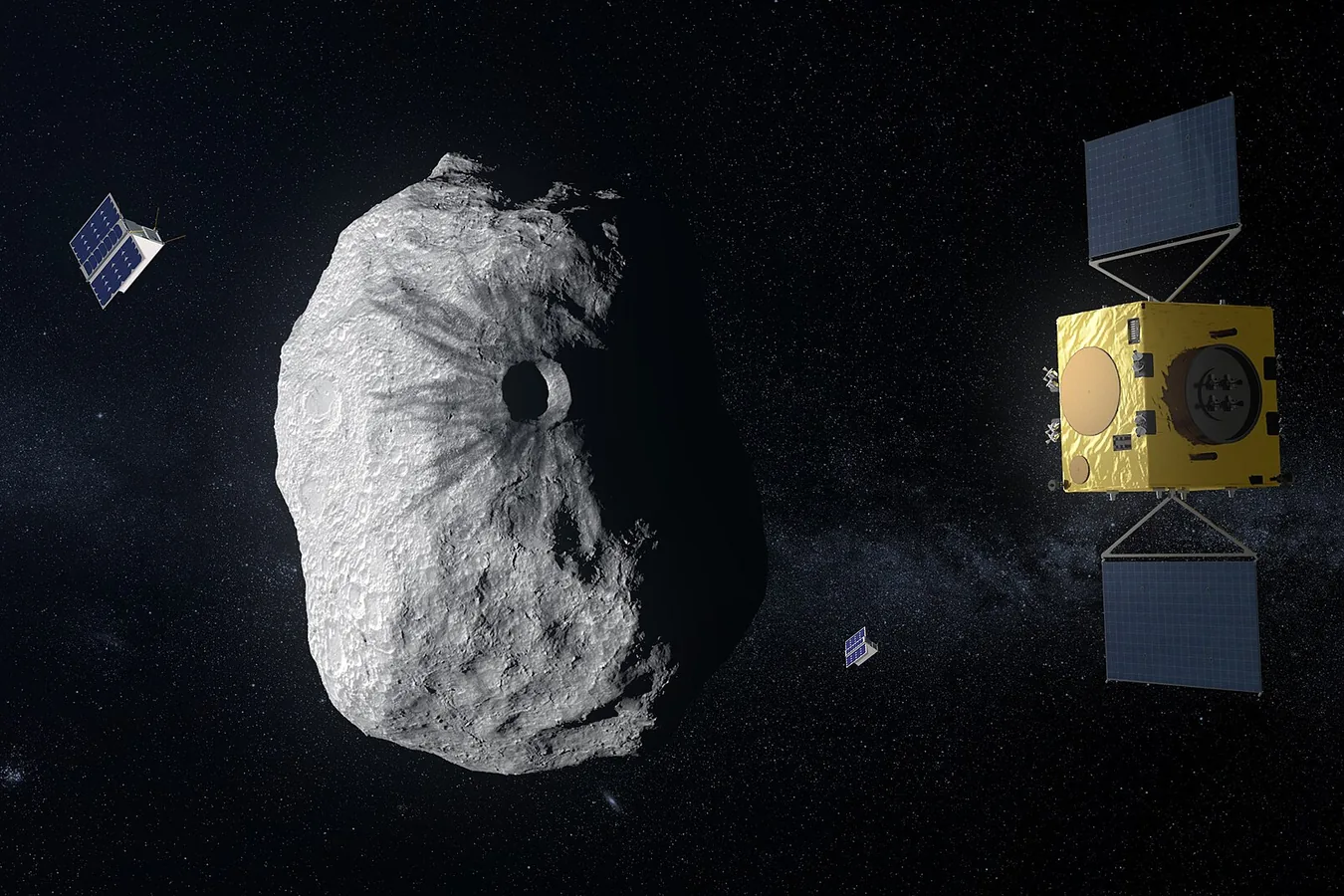
The European Space Agency announced on 27 October that Hera can now distinguish Didymos and Dimorphos. These are not yet detailed images of their surface.
In this article
What is new?
According to ESA, the two asteroids that previously appeared as a single point are now separated in Hera’s images. The smaller one, Dimorphos, still occupies only about one pixel.
Why study these objects?
In 2022, NASA’s DART probe struck Dimorphos and changed its orbital period. Hera is to examine the effects of that impact to better understand how a collision can deflect an asteroid.
What is left to observe?
The approach should allow more precise images and measurements. The shape, internal structure and mass will help interpret the impact experiment. The announcement describes an intermediate stage of this observation.
Understanding the word “pixel”
A pixel is a small element of a digital image. An object of about one pixel can be detected without its outline or relief being visible. So distinguish detecting an object from a detailed photograph.
Learn the grammar
French grammar
Learn sentence patterns and usage from the article’s own sentences.
01Negation and its scope
ne / n’ … pas · ne … plus
Il ne s’agit pas encore d’images détaillées de leur surface.Key pointsNormally ne and pas wrap the verb. Before a vowel, ne becomes n’. Check which part of the sentence the negation covers. Ne … plus means “no longer”.
02Citing a source with selon
selon + noun / organisation
Selon l’ESA, les deux astéroïdes qui apparaissaient auparavant comme un seul point sont désormais séparés dans les images de Hera.Key pointsSelon means “according to”. Put a person or organisation after it as the source. It separates facts the writer checked directly from what another body or report said. Citing a source does not turn a forecast into an accomplished fact.
03Pouvoir: ability and possibility
peut / peuvent / pourrait + infinitive
Hera doit examiner les effets de cet impact pour mieux comprendre comment une collision peut dévier un astéroïde.Key pointsPut a base-form verb after pouvoir. Peut means “can” or “may”; the conditional pourrait gives a more reserved possibility, “might”. It does not necessarily mean implementation is settled.
04The construction il s’agit de
il s’agit de + noun / infinitive
Il ne s’agit pas encore d’images détaillées de leur surface.Key pointsIt explains what something is about: “it is a matter of…”. The il is not a particular man but a formal subject of this construction. The negative il ne s’agit pas de means “this is not about…”.
05The passé composé for events
present of avoir + past participle
L’Agence spatiale européenne a annoncé le 27 octobre que Hera distingue désormais Didymos et Dimorphos.Key pointsIt reports past events, as in “announced” or “explained”. A / ont is the auxiliary avoir and the next word is the past participle. The passé composé alone does not tell you the date of the event.
06The present of être
est / sont + complement
Un pixel est un petit élément d’une image numérique.Key pointsEst is third-person singular and sont third-person plural of être. They express “is / are” — a state or description. If a past participle follows, it is a different structure such as the passive, so check the words that follow.
Japanese grammar
Understand the structure and usage from the text.
01Citing a source: によると
noun + によると
欧州宇宙機関(ESA)によると、これまで1つの点に見えていた2つの小惑星が、探査機ヘラの画像で別々に見えるようになりました。Key pointsAs in “LCPによると”, it shows where the information comes from. What that source reported follows. It is used differently from “私にとって”, which gives one’s own opinion.
02Defining a term with とは
noun + とは
画素とは、デジタル画像を作る小さな点のことです。Key pointsIt takes up a word, as in “在留資格とは?”, and asks for its meaning. In explanations it is used as “〜とは、…です”. Here the quotation と and the topic は are combined.
03Polite negation and plain form
〜ではありません / 〜ではない
まだ地表の細部が見える段階ではありません。Key pointsThey negate a noun and similar content. “ではありません” is the polite form and “ではない” the plain form. “成立ではありません” shows that it cannot be said to have been concluded.
04Cause or purpose with ため
〜ため / 〜ために
ヘラは、その影響を詳しく調べるための探査です。Key pointsため is used for both reason and purpose. “成立ではないため” is a reason and “運転手を守るため” a purpose. Decide from the whole sentence whether what precedes is a cause or a goal.
05Giving examples with など
noun / expression + など
表面の形、内部の構造、質量などを調べることで、衝突実験の結果を読み解きます。Key points“暴言など” gives “abusive language” as one example. It is not necessarily a closed list of only the things named. It also helps when reading the scope of a news story.
06The polite past ました
verb stem (連用形) + ました
欧州宇宙機関は27日、探査機ヘラがディディモスとディモルフォスを別々の天体として捉えたと発表しました。Key pointsIn “発表しました”, ました makes a verb polite past. The negative is “ませんでした”. Read the actual date together with the date and time in the text.