What is whisky?
Grain starch becomes sugar, yeast ferments it, and the liquid is distilled and aged in wood. New spirit is clear; much of the amber colour and woody character develops in the cask.
JAPANITIES · JAPANESE WHISKY
From grain to aroma. Explore Japanese whisky from the first essentials to the details of distillation: production, history, makers, casks and comparisons around the world.
Edited by JAPANITIES · Checked 4 November 2026
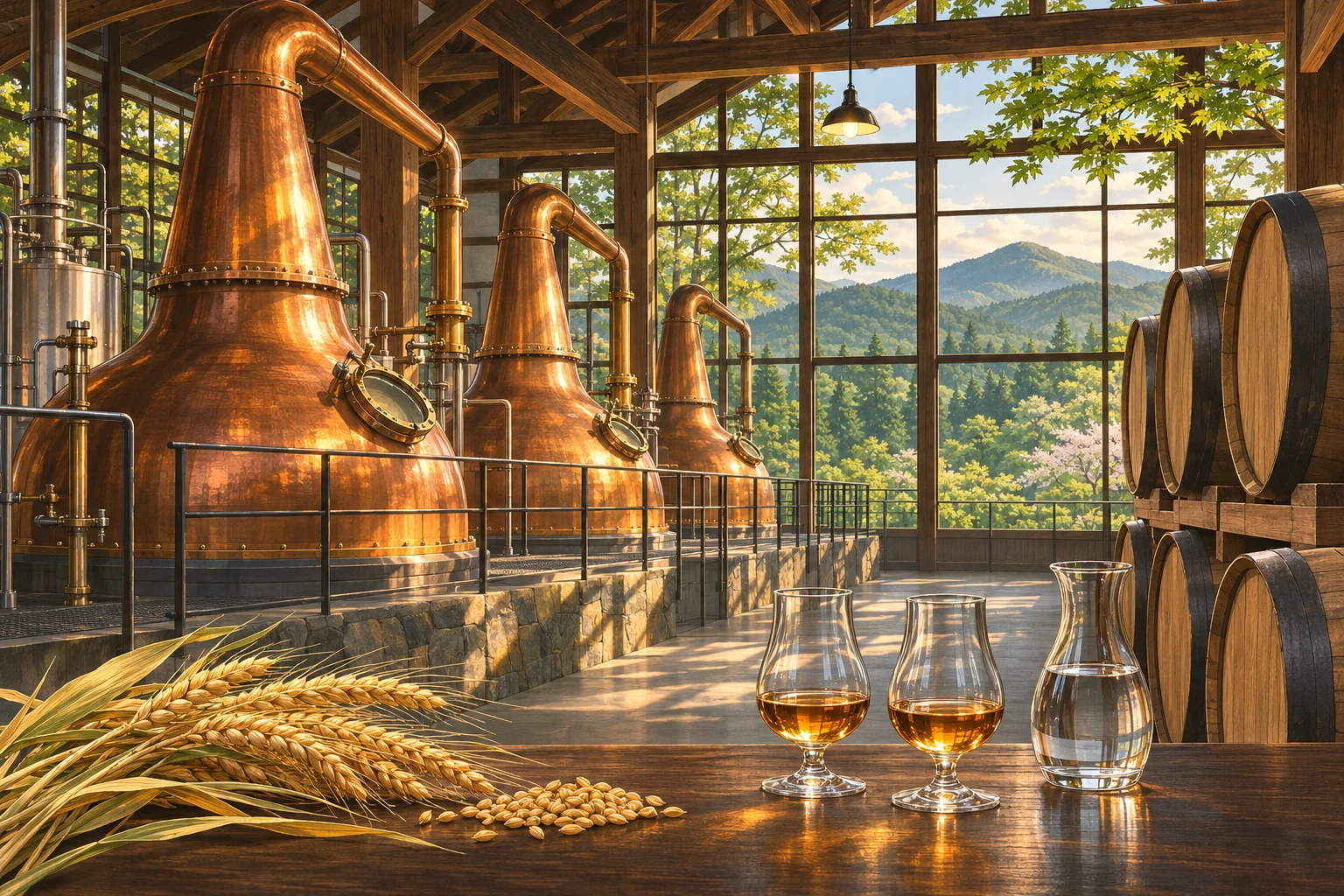
Three anchors: grain, distillation and casks.
Grain starch becomes sugar, yeast ferments it, and the liquid is distilled and aged in wood. New spirit is clear; much of the amber colour and woody character develops in the cask.
Sake is brewed from rice, koji and water. Whisky is a spirit: distillation follows grain fermentation. “Japanese alcohol” does not automatically mean sake.
Compare smoke, fruit and flowers, sweet-smelling oak, texture and finish. Age, cask and edition matter too. Tasting words are guides to perception, not quality rankings.
Sources : Suntory · Fabrication du whisky
↑ ContentsA maker’s nationality and the origin of its whisky are separate questions.
The JSLMA standard requires grain, mandatory malt and water drawn in Japan; saccharification, fermentation and distillation in Japan below 95% ABV; at least three years in Japan in wooden casks of at most 700 litres; and bottling in Japan at 40% ABV or more. Caramel may adjust colour.
It does not require all grain to be Japanese-grown or the use of mizunara. Three years is a minimum, not every product’s age. Local barley and Japanese wood are additional attributes.
Established in 2021, this industry standard had a transition ending in March 2024. Japanese lettering or a Japanese company does not establish the liquid’s origin. Read the specific product information. World blends have their own merits.
Sources : JSLMA · Critères du Japanese whisky · JSLMA · Logo et norme professionnelle (2025)
↑ Contents“Single” does not mean a single cask.
Malt whisky from one distillery, generally made with malted barley in pot stills. Several casks and ages can be combined. Examples include Yamazaki, Hakushu, Yoichi and Miyagikyo.
Often made with corn or wheat plus malt using continuous stills. “Single grain” refers to one distillery, not one grain. Chita and Nikka Coffey Grain reveal the character of spirits essential to blending.
Blended whisky combines malt and grain; Hibiki is an example. Blended malt combines malts from multiple distilleries. Taketsuru’s “pure malt” wording does not mean one cask or one distillery.
Nikka Coffey Malt uses 100% malted barley but a continuous Coffey still. Ingredients alone do not tell the production story. Coffey names the still, not a coffee flavour. Categories also need their regulatory context.
Sources : Scotch Whisky Association · Catégories · Nikka · Coffey Grain et Coffey Malt · Nikka · Gamme et assemblages · Suntory · Chita
↑ ContentsThis sequence mainly follows malt whisky. Grain whisky differs in cereal cooking and distillation equipment.
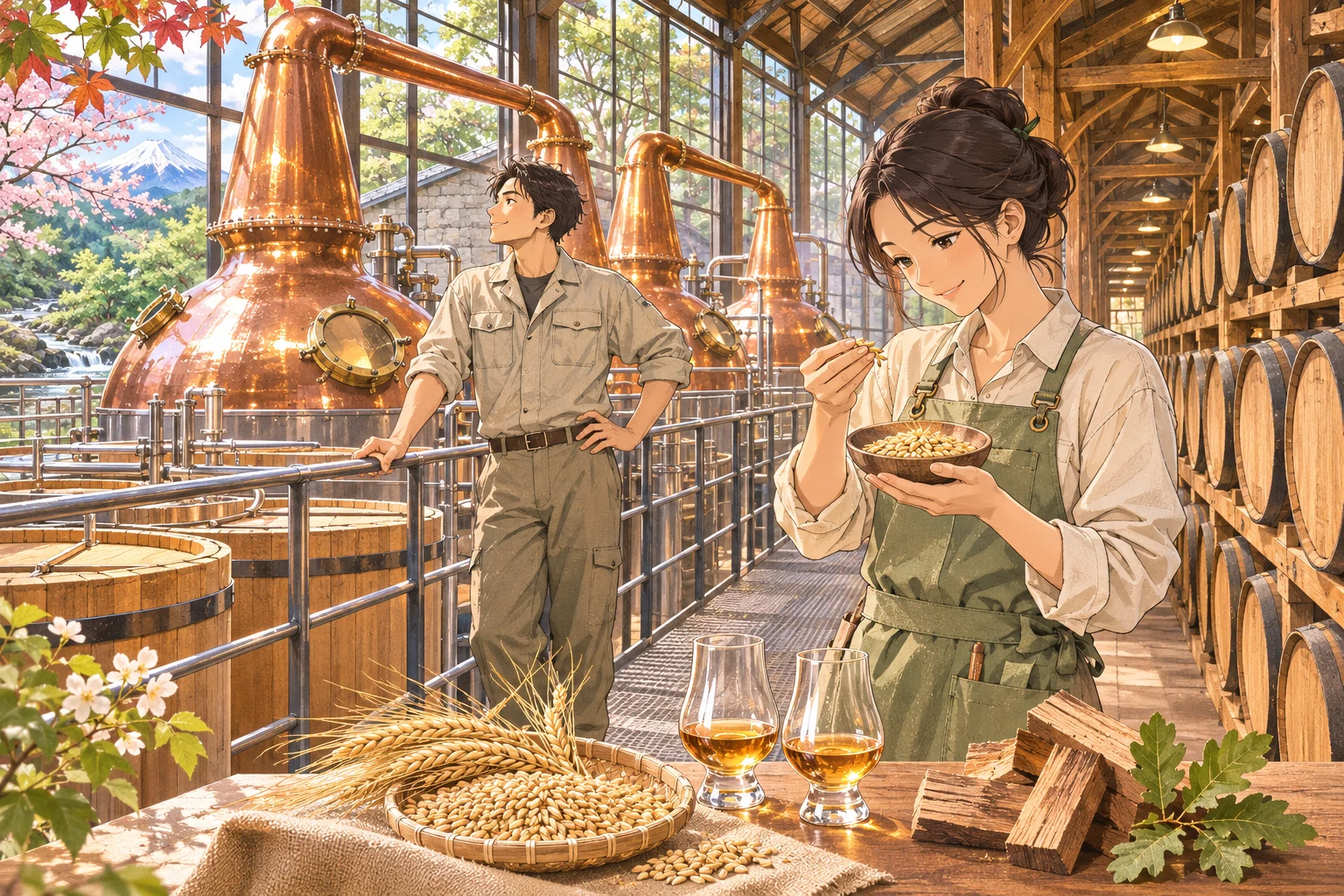
Moistened barley germinates, developing enzymes. Drying stops germination. Peat smoke may flavour the malt at this stage, but it is not always used.
Crushed malt meets hot water, allowing enzymes to turn starch into sugar. Milling balances extraction with drainage. Saccharification and fermentation are sequential here, unlike sake’s characteristic parallel process.
Yeast added to cooled wort produces alcohol and aroma compounds. Strain, temperature, time and vessel management shape the base. This low-strength fermented liquid has no cask character yet and is not the same as hopped beer.
Malt is often distilled twice in pot stills. Vapour is condensed back into liquid. Cuts during the second run define the central portion retained for its desired character.
Clear new make enters wood. Species, previous contents, reuse and filling strength all matter. Production planning now looks years or decades ahead.
Wood extraction, reactions including oxidation and evaporation work together. Temperature, humidity, cask size and condition affect development. Evaporative loss is the “angels’ share”. Rapid colour extraction does not guarantee balance.
Casks are assessed and combined for a target profile. Even single malt commonly combines casks. In blends, malt and grain jointly shape texture, continuity and finish.
Water may adjust strength before filtration and bottling. Some products avoid chill filtration or retain a strength close to the cask. Maturation age stops increasing in the bottle. This describes commercial production, not home distillation instructions.
Sources : Scotch Whisky Association · Du grain au verre · Suntory · Brassage et fermentation à Hakushu · Suntory Chita · Production de whisky de grain · Suntory Yamazaki · Maturation et mention d’âge · Scotch Whisky Association · Frequently asked questions
↑ ContentsNo single number predicts flavour: the parameters interact.
Fermentation creates aroma compounds and precursors, including fruity-smelling esters. Wooden vessels or longer fermentation do not automatically mean higher quality. Consider the distiller’s intended spirit.
Reflux returns some vapour to liquid within the still and influences compound selection. Neck, lyne arm and heating interact; a tall still does not guarantee lightness. Copper contact also influences sulphur compounds.
Yoichi is known for direct coal firing, while Miyagikyo malt uses indirect steam heating. Shizuoka uses both wood-fired and steam-heated wash stills. The fuel does not simply become smoke flavour in the glass.
Pot stills work in batches; continuous stills receive an ongoing feed. Column configuration and operation can produce different styles. Equating grain with no flavour or columns with poor quality misses the interest of Chita and Coffey whisky.
Heads, heart and tails describe distillation fractions. The boundaries of the heart influence aroma and body. A single temperature is not a universal rule: equipment and process matter.
Sources : Suntory · Brassage et fermentation à Hakushu · Nikka · Distilleries et méthodes · Gaiaflow · Fermentation et distillation à Shizuoka · Suntory Chita · Production de whisky de grain · Scotch Whisky Association · Du grain au verre · Annandale Distillery · Cuivre et distillation
↑ ContentsSeparate wood species, previous contents, reuse and time.
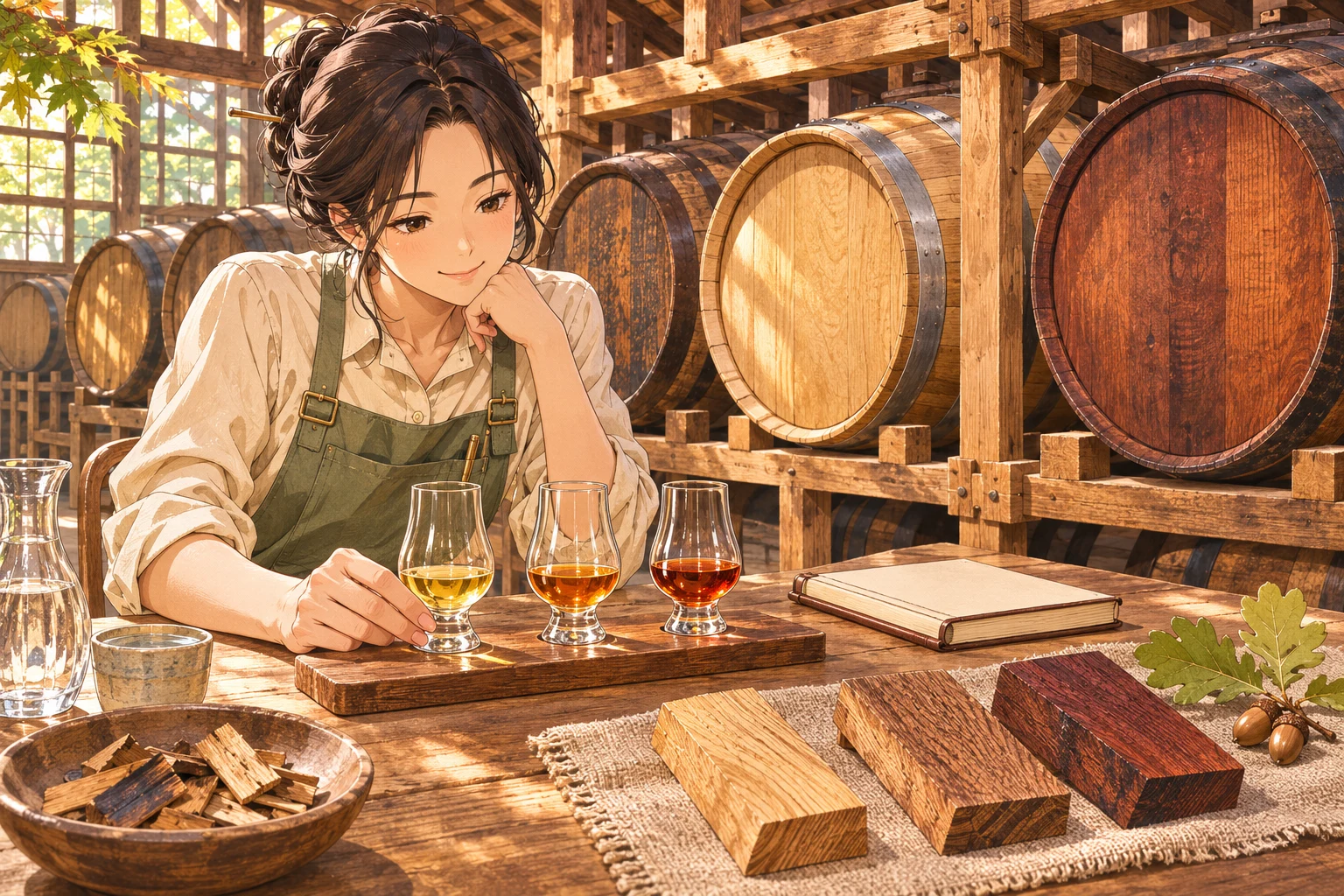
A cask previously used for bourbon. Vanilla, coconut and honey are common aroma associations, not added ingredients. “American oak” describes wood; “ex-bourbon” describes use.
Often associated with dried fruit, nuts and spice. Sherry style, oak species and reuse matter. Not every sherry-cask whisky is rich or sweet, and dark colour does not prove age.
This Japanese oak can develop sandalwood and incense-like associations with long maturation. It is emblematic, not mandatory; a blend may include only a proportion of mizunara-matured spirit.
New oak has not held spirit. “First fill” can mean the first malt filling of an ex-bourbon cask. Refill casks have seen more use; gentler oak can let the distillate show.
Main maturation and a finish in a second cask type are different. “Wine cask finish” does not mean the whole ageing period occurred in wine wood. Do not infer an unpublished duration.
Small casks offer more wood contact per liquid volume. Heat and temperature swings influence development, but fast extraction does not equal long-age complexity. Three Japanese years cannot be converted into a Scottish age.
Sources : Suntory · Types de fûts · Suntory · Réutilisation des fûts · Suntory · Origine des fûts de mizunara · Suntory Yamazaki · Maturation et mention d’âge
↑ ContentsSimilar-sounding terms can describe different things.
The age generally refers to the youngest whisky in the blend, not an average. A 12-year whisky may include older spirit. Another ten years in a bottle does not make it a 22-year whisky.
NAS focuses on a profile without stating an age. It need not contain only young whisky. No age statement does not mean poor quality, and older is not automatically better for every palate.
Single cask means one cask; cask strength concerns strength close to the cask. Cask-strength whisky can combine multiple casks. Single malt, single cask and unreduced are not synonyms; check the bottling details.
Chill filtration reduces compounds that can cause haze when cold or diluted. Non-chill-filtered does not mean no filtration of any kind. Natural colour concerns colouring. Neither phrase alone guarantees quality.
Sources : Suntory Yamazaki · Maturation et mention d’âge · Scotch Whisky Association · Frequently asked questions · JSLMA · Critères du Japanese whisky
↑ ContentsFounding, first distillation and product launch are different milestones.
Masataka Taketsuru studies Scottish production, marries Rita and returns to Japan. That technical and personal experience becomes an important foundation for Japanese whisky.
Shinjiro Torii’s Kotobukiya starts Yamazaki with Taketsuru involved in production. Construction begins in 1923 and finishes in 1924, a defining step for Japanese malt whisky.
Suntory Whisky, nicknamed Shirofuda, is launched. The interval illustrates the investment and maturation required before a first whisky reaches the market.
Taketsuru establishes Dai Nippon Kaju at Yoichi, Hokkaido, later Nikka. The business must sustain itself while spirit matures; its first Nikka Whisky is released in 1940.
Kakubin in 1937 and Old in 1950 help establish blended whisky. Post-war bars and home drinking contribute to the developing culture.
Miyagikyo opens in 1969, Chita in 1972 and Hakushu in 1973. Different locations and equipment broaden blending options, not just production volume.
Yamazaki single malt launches in 1984, followed by Hibiki in 1989. Distillery expression and blending become complementary faces of Japanese whisky.
Chichibu starts production in 2008 and releases its first single malt in 2011; Akkeshi begins distilling in 2016. Diverse locations, equipment and materials make a single “Japanese taste” increasingly reductive.
The JSLMA standard arrives in 2021, its transition ends in March 2024, and a logo is announced in 2025. Traceability of origin and process matters alongside reputation.
Sources : Suntory · Chronologie des cent ans · Nikka · Histoire · Suntory · Chita · METI Kantō · Entretien avec Venture Whisky · Akkeshi · La distillerie et ses whiskies · JSLMA · Logo et norme professionnelle (2025)
↑ ContentsA guide to differences, not a ranking. Age, cask and edition can change the profile.
An entry point into fruit, oak and body. Mizunara and wine casks form part of its palette, depending on the release. Distinguish the distillery name from specific age-stated versions.
Look for herbal associations, freshness and smoke. Its forest setting is famous, but “forest aroma” is also sensory language, not proof that the landscape directly enters the spirit.
Suntory blends Yamazaki and Hakushu malts with Chita grain. Consider continuity from aroma to texture and finish. The product does not come from a single “Hibiki distillery”.
Explore the smooth texture of grain whisky made mainly from corn. It is more than a blending component. Use similar dilution when comparing highballs.
Nikka’s distillery is known for direct coal firing. It offers a way to explore body and smoke without assuming identical peat intensity across releases.
Malt production uses indirect steam heating. Compared with Yoichi, explore fruit, floral notes and texture. Knowing both helps explain Nikka blends.
Combines Yoichi and Miyagikyo malt. It helps distinguish all-malt blending from malt-and-grain blending. The name honours the founder, not a distillery called Taketsuru.
Two expressions of Coffey distillation: grain mainly from corn and malt from 100% malted barley. Compare ingredients, texture and cereal or sweet aroma associations.
Venture Whisky is led by Ichiro Akuto. Chichibu single malt and the broader Ichiro’s Malt range are not interchangeable. Check Chichibu, Malt & Grain or World Blended wording and declared composition.
Hombo Shuzo’s Mars whiskies connect Komagatake in Nagano and Tsunuki in Kagoshima. They invite comparisons between distillation and maturation locations; combinations vary by series.
This eastern Hokkaido distillery explores peat and local identity. Check the category across its different expressions. Seasonal names do not automatically indicate age or flavour.
Gaiaflow uses wood firing, steam heating and Japanese cedar washbacks among its tools. It is a useful study in equipment, fermentation and spirit selection.
Sources : Suntory · Yamazaki · Suntory · Histoire de Hakushu 12 ans · Suntory · Les whiskies qui composent Hibiki · Suntory · Chita · Nikka · Distilleries et méthodes · Nikka · Gamme et assemblages · Nikka · Coffey Grain et Coffey Malt · METI Kantō · Entretien avec Venture Whisky · Hombo Shuzo · Distillerie de Komagatake · Hombo Shuzo · Single malt Tsunuki · Akkeshi · La distillerie et ses whiskies · Gaiaflow · Fermentation et distillation à Shizuoka
↑ Contents“Japan is delicate, Scotland is smoky” misses the real diversity.
Several Japanese companies make a wide range of malts and grains for their blends. Exchanges such as Mars–Chichibu and Mars–Akkeshi show that inter-company spirit exchange is not absent.
Scotch is made in Scotland, aged at least three years in oak casks of no more than 700 litres and bottled at 40% ABV or more. Note “oak” versus “wood” in the Japanese industry standard. Many malts are fruity and unpeated.
US bourbon uses at least 51% corn in its grain mash, is distilled at no more than 80% ABV and enters new charred oak at no more than 62.5%. Straight bourbon requires at least two years, but not all bourbon has that blanket minimum. New-oak character is a useful comparison.
Irish Whiskey is produced on the island of Ireland and aged at least three years in wood. Triple distillation is well known but not universally required. Pot still traditions using malted and unmalted barley offer cereal and spice character.
France also makes whisky. The Whisky de Bretagne GI links local water and at least three years of maturation in its oceanic climate. For a useful Japan–France comparison, try to match cask type and strength.
Record strength, cask, age statement and peat. Two unpeated malts mainly from ex-bourbon casks are easier to compare than opposite styles. Ask what explains your perception rather than which wins.
Sources : Hombo Shuzo · Échange de malts Tsunuki × Akkeshi · Scotch Whisky Association · Protection du Scotch · TTB · Bourbon et straight bourbon · DAFM Irlande · Cahier des charges Irish Whiskey · INAO · Whisky de Bretagne
↑ ContentsStart with a small pour and water alongside.
Smell from a little distance, taste, then add a little water and observe aroma and alcohol sensation. Putting your nose too close can emphasise alcohol. Water’s effect varies with whisky and amount.
Pour whisky over ice in a chilled glass, then gently add soda. Start around one part whisky to three or four parts soda. Stir lightly; lemon is optional. A 1:3 mix with 40% whisky is about 10% before ice melt.
Ice cools and dilutes gradually; compare the first sip with later ones. A small narrowing glass suits aroma observation, while a tall glass suits highballs. Expensive glassware is not essential.
Record product and edition; strength, cask and age; nose; texture and palate; finish. Note water or ice too. Familiar words such as apple, toast or smoke are useful tasting language.
Sources : Scotch Whisky Association · Frequently asked questions
↑ ContentsJAPANITIES pairing ideas, not universal verdicts on brands.
Try karaage, tempura or fries: soda freshness meets a toasted crust. For delicate seafood, start without heavy peat.
With aged Comté, explore nutty and savoury overlap. Small bites and sips make the comparison easier.
Try a little grilled or smoked meat. If both elements are strongly smoky, nuances can disappear. Salt and fat also change the balance.
Try raisins, figs or a little chocolate. Very sweet food may make whisky seem bitter; vary sweetness. Personal preference matters.
Choose for curiosity, not rarity alone.
Set a budget and consider smoke, fruit and oak preferences. Small pours at a reputable bar or miniatures let you learn without starting with rare bottles. Price also reflects scarcity, not just enjoyment.
Compare the same product, volume, strength and edition. Do not infer origin from kanji or Japanese-style packaging. Read provenance and seller information. This is an educational guide, not a price list.
Keep bottles upright and tightly closed, away from sunlight, heat and strong smells. After opening, fill level and storage affect changes; this is not cask maturation. Recording the opening date is useful.
Look at washbacks, still shapes, heating and warehouses. Reservations, hours and tasting rules can change; check the distillery. Plan transport without driving after tasting.
Sources : Suntory · Conservation des spiritueux · Scotch Whisky Association · Frequently asked questions · Hombo Shuzo · Distillerie de Komagatake
↑ ContentsSources : Scotch Whisky Association · Du grain au verre · Scotch Whisky Association · Frequently asked questions · Nikka · Coffey Grain et Coffey Malt · Suntory Yamazaki · Maturation et mention d’âge
No. Ex-bourbon, sherry and other casks are used. The JSLMA standard does not require mizunara.
It is a category, not a quality rank. Blending also involves skill and distinctive character.
Vanilla or fruit aromas can suggest sweetness without meaning added sugar. Liqueurs are a different category; read their ingredients.
No. Cask maturation and bottle storage are different. An old bottle is not necessarily well preserved.
No: check each product. Distinguish international blends from products meeting Japan-based production criteria.
Smoke preference and experience are separate. Experienced enthusiasts may prefer unpeated whisky.