Serbia: Vučić concedes defeat, the Students’ List wins the parliamentary elections
Checked on
Published on
In Serbia’s 25 October parliamentary elections, Aleksandar Vučić conceded defeat in the evening. The Students’ List would win 135 to 140 seats. Official results had not yet been published.
In this article
The essentials
According to Euronews, on the evening of 25 October, outgoing president Aleksandar Vučić admitted defeat in a brief statement: “from the stratified sample, it is clear that we have lost the elections”. He said the Students’ List would have between 135 and 140 seats and his camp about 105, out of 250. This follows our article of yesterday on the vote.
The figures
According to Vučić, the Serbian Progressive Party (SNS) collected about 1.72 million votes and the Students’ List 2.2 million. Euronews also reports “52% against 32.3%”, without specifying the basis of these percentages, which do not match the votes. Vučić also mentioned three seats for the Alliance of Vojvodina Hungarians and one for the Albanians; yet he said that “nobody else entered Parliament”, which is contradictory. The figures may change when official results are published.
The context
The Students’ List came out of months of protests denouncing corruption and media control and demanding accountability, which reached beyond campuses, including part of the urban middle class, according to Euronews. According to AP (yesterday’s article), the movement was born from the collapse of a canopy at the Novi Sad station, which killed 16 people. Euronews sees in it a rejection of the political model dominant for over ten years (the author’s analysis).
And now?
Euronews cites among the challenges the economy, foreign policy, relations with the EU, Kosovo, energy, public finances and ties with Russia and China, as well as expectations on judicial and media independence and the fight against corruption. Vučić’s future is uncertain and his party will have to rebuild in opposition.
What we do not know yet
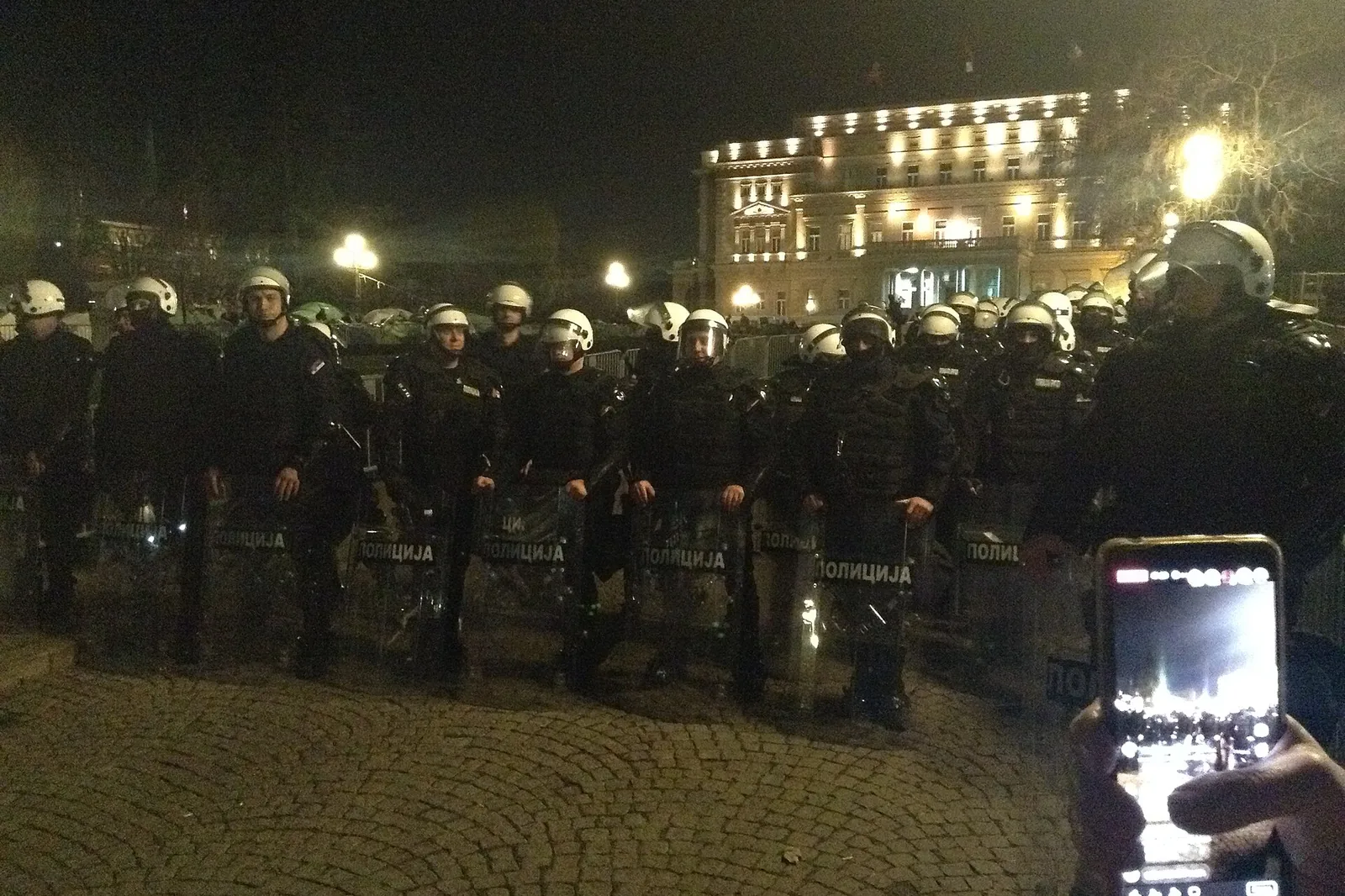
In the article consulted, the turnout, the exact distribution of seats, the date of the official results and the name of the future Prime Minister are not given; reactions from the EU and the protesters appear only in a photo caption.
Learn the grammar
French grammar
Learn sentence patterns and usage from the article’s own sentences.
01The present indicative
est / sont + attribute (noun, adjective, prepositional phrase)
Selon Euronews, dans la soirée du 25 octobre, Aleksandar Vučić, président sortant, a reconnu sa défaite dans une brève déclaration : « d’après l’échantillon stratifié, il est clair que nous avons perdu les élections ».Key pointsÊtre in the present is est for a singular subject and sont for a plural one. It describes nature, state or place (“is”, “is located”). If what follows (the attribute) is a noun, adjective or prepositional phrase, it is not a passive. If a past participle follows, it is a passive (est annoncé). Headlines and summaries often use the present to describe the current situation.
02The passé composé
present of avoir + past participle
Aux législatives serbes du 25 octobre, Aleksandar Vučić a reconnu sa défaite dans la soirée.Key pointsThe passé composé is the most common past tense, used for “did” and “has done” — actions completed in the past. It is formed with the auxiliary avoir (a / ont…) in the present + a past participle. Past participles of -er verbs end in -é (annoncer → annoncé); learn the irregular ones (faire → fait, prendre → pris, voir → vu). In the negative, ne … pas wraps the auxiliary (n’a pas annoncé). In the news it reports facts that have already happened, such as “announced” or “voted”.
03The futur simple
stem (infinitive) + -ai / -as / -a / -ons / -ez / -ont
L’avenir de Vučić est incertain et son parti devra se reconstruire dans l’opposition.Key pointsThe futur simple means “will do” or “is planned to”. Add -ai, -as, -a, -ons, -ez, -ont to the infinitive (participer → il participera). Watch the irregular stems: être → ser-, avoir → aur-, aller → ir-, faire → fer-, pouvoir → pourr-, voir → verr-. In the news it is used for fixed plans and outlooks.
04The present conditional
stem (infinitive) + -ais / -ait / -ions / -iez / -aient
La Liste des étudiants obtiendrait de 135 à 140 sièges.Key pointsThe conditional expresses possibility, supposition, unconfirmed information and polite requests (“would”, “might”). It uses the same stem as the future and the same endings as the imparfait (-ais, -ait, -ions, -iez, -aient): pouvoir → il pourrait. In the news it is used to avoid asserting, as in “is reported to…” or “there is a possibility…”.
05The passive voice in the present
être (est / sont) + past participle (+ par / de)
In the article consulté, la participation, la répartition exacte des sièges, la date des résultats officiels et le nom du futur Premier ministre ne sont pas indiqués ; les réactions de l’UE et des manifestants n’apparaissent que dans une légende de photo.Key pointsThe passive means “is done” or “is being done”. It is formed with être + past participle, which agrees with the subject in gender and number (la mesure est adoptée / les mesures sont adoptées). The agent is introduced by par (or de). In the news it is common when the event, rather than the actor, is the focus (est prévu / est annoncé / est connu).
06Negation and its scope
ne / n’ … pas · ne … plus
Les résultats officiels n’étaient pas encore publiés.Key pointsNormally ne and pas wrap the verb. Before a vowel, ne becomes n’. Check which part of the sentence the negation covers. Ne … plus means “no longer”.
07Citing a source with selon
selon + noun / organisation
Selon Euronews, dans la soirée du 25 octobre, Aleksandar Vučić, président sortant, a reconnu sa défaite dans une brève déclaration : « d’après l’échantillon stratifié, il est clair que nous avons perdu les élections ».Key pointsSelon means “according to”. Put a person or organisation after it as the source. It separates facts the writer checked directly from what another body or report said. Citing a source does not turn a forecast into an accomplished fact.
08Pouvoir: ability and possibility
peut / peuvent / pourrait + infinitive
Les chiffres peuvent changer à la publication des résultats officiels.Key pointsPut a base-form verb after pouvoir. Peut means “can” or “may”; the conditional pourrait gives a more reserved possibility, “might”. It does not necessarily mean implementation is settled.
09Purpose with pour
pour + infinitive
La Liste des étudiants est issue de mois de manifestations pour dénoncer la corruption, le contrôle des médias et réclamer des comptes, qui ont touché au-delà des campus, y compris une partie de la classe moyenne urbaine, selon Euronews.Key pointsThis is the purpose, “in order to…”. Put the base form of a verb after pour. The purpose stated here is separate from whether the effect was actually achieved.
10The subject relative pronoun qui
noun + qui + verb
Euronews rapporte aussi « 52 % contre 32,3 % », sans préciser la base de ces pourcentages, qui ne concordent pas avec les voix.Key pointsQui continues a description of the person or thing just mentioned (“the one that does…”). Because qui is itself the subject of the next verb, do not repeat the subject. The verb agrees with the noun qui refers to.
Japanese grammar
Understand the structure and usage from the text.
01Citing a source: によると
noun + によると
ユーロニュースによると、25日の夜、ブチッチ氏(前大統領)は、短い声明で、選挙に負けたと認めました。Key pointsAs in “LCPによると”, it shows where the information comes from. What that source reported follows. It is used differently from “私にとって”, which gives one’s own opinion.
02Defining a term with とは
noun + とは
「層化抽出の標本から、私たちが負けたことは、はっきりしている」と述べたと伝えられています。Key pointsIt takes up a word, as in “在留資格とは?”, and asks for its meaning. In explanations it is used as “〜とは、…です”. Here the quotation と and the topic は are combined.
03Expressing a possibility
〜可能性がある / 〜かもしれない
公式の結果が出るまで、数字は、変わる可能性があります。Key pointsThese forms say something may happen. Even when “possibility” is written, it does not mean it will certainly happen. Check whose forecast it is, plus the time and conditions.
04The polite past ました
verb stem (連用形) + ました
25日に行われたセルビアの総選挙で、ブチッチ氏は、夜に、敗北を認めました。Key pointsIn “発表しました”, ました makes a verb polite past. The negative is “ませんでした”. Read the actual date together with the date and time in the text.
05Quoting with と: content and report
plain-form sentence + と + verbe de parole (報じる, 説明する…)
ブチッチ氏の将来は、はっきりせず、党は、野党として、立て直す必要があるとされています。Key pointsと takes the content that is reported or explained. In “改定する方針だと報じました”, “改定する方針だ” is what the report said. Separating the content from who said it and how makes long sentences easier to read.
06Treating a clause like a noun with こと
plain-form sentence + こと + particle
「層化抽出の標本から、私たちが負けたことは、はっきりしている」と述べたと伝えられています。Key points“〜すること” treats an action or content like a noun. The particle after it (が・を・は…) shows its role in the sentence. “ことができる” is a fixed combination meaning “can”.