Japan: Typhoon No. 30 passes near Guam, expected south of Okinawa around 22–23 October
Checked on
Published on
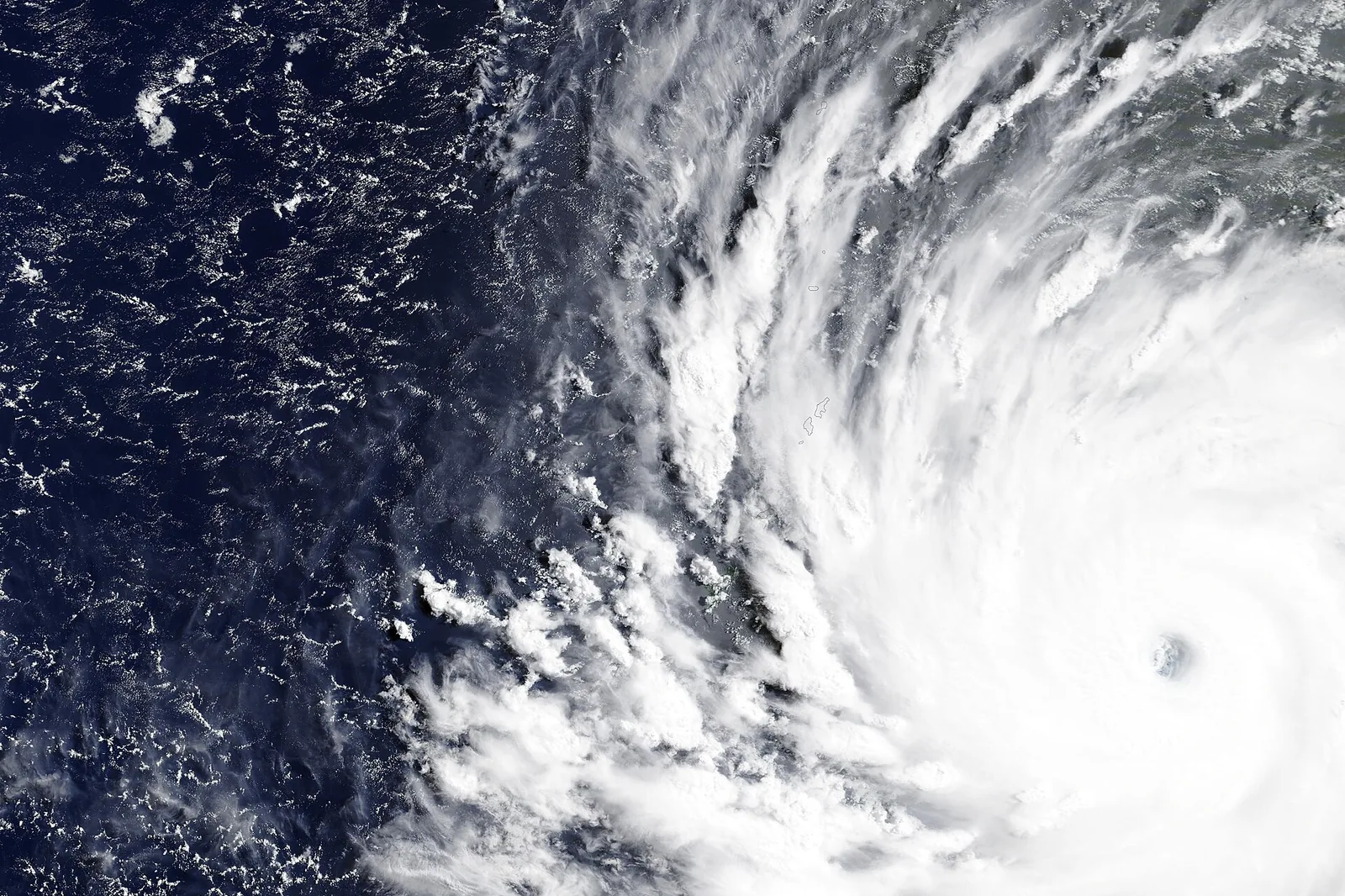
Weathernews information (18 October, 9 am) and Japan Meteorological Agency forecasts. The typhoon is “very strong” and could become “violent” between this evening and the morning of the 19th.
In this article
Current situation
According to Weathernews, Typhoon No. 30 (Champi) was on 18 October at 9 am in the Mariana Islands, near Guam, moving west at 25 km/h. Central pressure: 945 hPa; maximum wind: 50 m/s; maximum gusts: 70 m/s. It is “very strong” and could become “violent” from this evening to the morning of Monday the 19th.
When for Okinawa?
Weathernews forecasts it will reach the sea south of Okinawa at the end of the week. According to HBC (Yahoo! Japan), relaying the Japan Meteorological Agency (18 October, 6:45 am), it would reach the south of Okinawa around 3 am on the 23rd, with 935 hPa and gusts of 70 m/s. Forecasts vary from hour to hour: check the latest.
What effects in Japan?
Weathernews expects effects mainly on the Sakishima Islands, with wind and waves growing stronger even at a distance. Probability of entering the storm zone within five days (Meteorological Agency): 5% for the Miyako region, 13% for Ishigaki, 6% for Yonaguni. Effects on Honshu are not mentioned in this source.
The track remains uncertain
A high-pressure system should rather make the typhoon drift west, but uncertainty remains and some AI models bring it north through the East China Sea. A different track would change the effects in Japan.
Before a trip
If you are going to Okinawa or the Sakishima Islands, check the Meteorological Agency’s typhoon information and airline and ferry notices before leaving. The figures in this article are those of the time indicated; rely on the latest official information.
Learn the grammar
French grammar
Learn sentence patterns and usage from the article’s own sentences.
01The present indicative
est / sont + attribute (noun, adjective, prepositional phrase)
Les chiffres de cet article sont ceux de l’heure indiquée ; fiez-vous aux informations officielles les plus récentes.Key pointsÊtre in the present is est for a singular subject and sont for a plural one. It describes nature, state or place (“is”, “is located”). If what follows (the attribute) is a noun, adjective or prepositional phrase, it is not a passive. If a past participle follows, it is a passive (est annoncé). Headlines and summaries often use the present to describe the current situation.
02The passé composé
present of avoir + past participle
Les chiffres viennent des entreprises ou des organismes cités ; JAPANITIES ne les a pas vérifiés.Key pointsThe passé composé is the most common past tense, used for “did” and “has done” — actions completed in the past. It is formed with the auxiliary avoir (a / ont…) in the present + a past participle. Past participles of -er verbs end in -é (annoncer → annoncé); learn the irregular ones (faire → fait, prendre → pris, voir → vu). In the negative, ne … pas wraps the auxiliary (n’a pas annoncé). In the news it reports facts that have already happened, such as “announced” or “voted”.
03The imparfait
stem (nous form of the present) + -ais / -ait / -ions / -iez / -aient
D’après Weathernews, le typhon n° 30 (Champi) se trouvait le 18 octobre à 9 h dans les îles Mariannes, près de Guam, se déplaçant vers l’ouest à 25 km/h.Key pointsThe imparfait describes states, background, habits and actions in progress in the past (il était, elle avait, ils pensaient). Take the nous form of the present, drop -ons, and add -ais / -ais / -ait / -ions / -iez / -aient. If the passé composé gives “the event itself”, the imparfait paints “the situation at the time”.
04The futur simple
stem (infinitive) + -ai / -as / -a / -ons / -ez / -ont
Weathernews prévoit qu’il atteindra la mer au sud d’Okinawa en fin de semaine.Key pointsThe futur simple means “will do” or “is planned to”. Add -ai, -as, -a, -ons, -ez, -ont to the infinitive (participer → il participera). Watch the irregular stems: être → ser-, avoir → aur-, aller → ir-, faire → fer-, pouvoir → pourr-, voir → verr-. In the news it is used for fixed plans and outlooks.
05The present conditional
stem (infinitive) + -ais / -ait / -ions / -iez / -aient
Le typhon est « très fort » et pourrait devenir « violent » entre ce soir et le matin du 19.Key pointsThe conditional expresses possibility, supposition, unconfirmed information and polite requests (“would”, “might”). It uses the same stem as the future and the same endings as the imparfait (-ais, -ait, -ions, -iez, -aient): pouvoir → il pourrait. In the news it is used to avoid asserting, as in “is reported to…” or “there is a possibility…”.
06The passive voice in the present
être (est / sont) + past participle (+ par / de)
Les effets sur Honshu ne sont pas évoqués dans cette source.Key pointsThe passive means “is done” or “is being done”. It is formed with être + past participle, which agrees with the subject in gender and number (la mesure est adoptée / les mesures sont adoptées). The agent is introduced by par (or de). In the news it is common when the event, rather than the actor, is the focus (est prévu / est annoncé / est connu).
07The imperative
present vous form (-ez) / nous (-ons) / tu
Les prévisions varient d’une heure à l’autre : consultez la dernière.Key pointsThe imperative expresses commands, requests and advice. It has no subject: the sentence starts with the verb (Consultez les informations.). The vous form ends in -ez, nous in -ons (Restons prudents.), and tu in -e for -er verbs (Consulte). It is very common in notices and warnings (Vérifiez, Consultez, Restez informé).
08Pronominal verbs
se / s’ + verb
D’après Weathernews, le typhon n° 30 (Champi) se trouvait le 18 octobre à 9 h dans les îles Mariannes, près de Guam, se déplaçant vers l’ouest à 25 km/h.Key pointsA pronominal verb is used with a reflexive pronoun (me, te, se, nous, vous) before the verb. It can mean “do to oneself”, “be done” or “do to each other”. In the news, se traduire (to result in), se tenir (to take place), s’agir de (to be a matter of) and se diffuser (to spread) are frequent. The pronoun changes with the subject (il se tient / ils se tiennent / je me souviens).
09Negation and its scope
ne / n’ … pas · ne … plus
Les effets sur Honshu ne sont pas évoqués dans cette source.Key pointsNormally ne and pas wrap the verb. Before a vowel, ne becomes n’. Check which part of the sentence the negation covers. Ne … plus means “no longer”.
10Citing a source with selon
selon + noun / organisation
Selon HBC (Yahoo!Key pointsSelon means “according to”. Put a person or organisation after it as the source. It separates facts the writer checked directly from what another body or report said. Citing a source does not turn a forecast into an accomplished fact.
11Pouvoir: ability and possibility
peut / peuvent / pourrait + infinitive
Le typhon est « très fort » et pourrait devenir « violent » entre ce soir et le matin du 19.Key pointsPut a base-form verb after pouvoir. Peut means “can” or “may”; the conditional pourrait gives a more reserved possibility, “might”. It does not necessarily mean implementation is settled.
12Expressing a plan or a deadline
être prévu / prévoir / être envisagé
Weathernews prévoit qu’il atteindra la mer au sud d’Okinawa en fin de semaine.Key pointsPrévoir means “to plan, to expect”. Être prévu means “to be scheduled” and être envisagé means “to be under consideration”. In the news, read them separately from expressions that describe events that have already happened. They do not say that the event has already taken place.
13The subject relative pronoun qui
noun + qui + verb
Japan), qui relaie l’Agence météorologique japonaise (18 octobre, 6 h 45), il atteindrait le sud d’Okinawa vers 3 h le 23, avec 935 hPa et des rafales de 70 m/s.Key pointsQui continues a description of the person or thing just mentioned (“the one that does…”). Because qui is itself the subject of the next verb, do not repeat the subject. The verb agrees with the noun qui refers to.
Japanese grammar
Understand the structure and usage from the text.
01Citing a source: によると
noun + によると
ウェザーニュースによると、台風30号(チャンパー)は18日9時の時点で、マリアナ諸島にあって、グアム島の近くを西へ時速25kmで進んでいます。Key pointsAs in “LCPによると”, it shows where the information comes from. What that source reported follows. It is used differently from “私にとって”, which gives one’s own opinion.
02Expressing a possibility
〜可能性がある / 〜かもしれない
高気圧の影響で、西寄りに進む可能性が高いとされています。Key pointsThese forms say something may happen. Even when “possibility” is written, it does not mean it will certainly happen. Check whose forecast it is, plus the time and conditions.
03Cause or purpose with ため
〜ため / 〜ために
発表の時刻によって予報に差があるため、最新の発表を確認してください。Key pointsため is used for both reason and purpose. “成立ではないため” is a reason and “運転手を守るため” a purpose. Decide from the whole sentence whether what precedes is a cause or a goal.
04Giving examples with など
noun / expression + など
本州などへの影響は、参照した資料には書かれていません。Key points“暴言など” gives “abusive language” as one example. It is not necessarily a closed list of only the things named. It also helps when reading the scope of a news story.
05Quoting with と: content and report
plain-form sentence + と + verbe de parole (報じる, 説明する…)
ウェザーニュースは、週の後半に沖縄の南の海上に達する見通しだと伝えています。Key pointsと takes the content that is reported or explained. In “改定する方針だと報じました”, “改定する方針だ” is what the report said. Separating the content from who said it and how makes long sentences easier to read.
06Linking actions with the て-form
verb て-form + next expression
強さは「非常に強い」で、今夜から19日朝にかけて一時的に「猛烈な」勢力になる予想です。Key pointsThe て-form links actions in a series, in order or as a reason. In “確認して、出発する” the relation is judged from the content. In “〜ている” it can show an action in progress or a continuing state.