Japan: successful launch of the MMX probe to Mars’s moon Phobos
Checked on
Published on
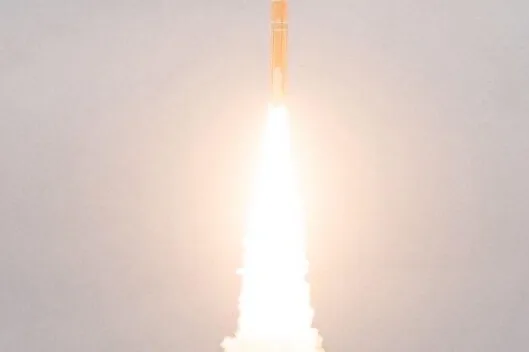
JAXA successfully launched H3 rocket No. 10 on 20 October. MMX’s goals and the journey ahead.
In this article
The essentials
JAXA successfully launched the MMX probe on 20 October with H3 rocket No. 10. It is to bring back samples from Phobos, a moon of Mars.
The launch
Lift-off from Tanegashima at 4:41 am. The solid boosters separated after 1 min 56 s, the first stage shut down at about 5 minutes and the probe was separated about 71 minutes after lift-off, in the planned orbit. It was the first flight of the H3-24L configuration (16.4 m fairing) and the first launch of a planetary probe by H3.
Why Phobos?
The origin of Phobos is unknown: an asteroid captured by Mars or the result of a giant impact. If capture is the right hypothesis, Phobos could be rich in hydrated minerals and organic matter, like the asteroid Ryugu. Analysis of the samples should shed light on the transport of water and organic compounds during the formation of the Solar System.
The journey ahead
Arrival near Mars in August 2027, insertion into orbit around Mars then observation from a quasi-satellite orbit of Phobos. Two landings, for more than 10 g of material. Departure from Mars in November 2030 and return to Earth in July 2031, with recovery of the capsule in Australia, as for Hayabusa and Hayabusa2. Total duration: about five years.
International cooperation
The gas-based sampling device is provided by NASA. The IDEFIX rover, which will land first on Phobos to study its surface, was developed by CNES (France) and DLR (Germany).
To keep in mind
The arrival and return dates are forecasts and may change.
Learn the grammar
French grammar
Learn sentence patterns and usage from the article’s own sentences.
01The present indicative
est / sont + attribute (noun, adjective, prepositional phrase)
L’origine de Phobos est inconnue : astéroïde capturé par Mars ou résultat d’un impact géant.Key pointsÊtre in the present is est for a singular subject and sont for a plural one. It describes nature, state or place (“is”, “is located”). If what follows (the attribute) is a noun, adjective or prepositional phrase, it is not a passive. If a past participle follows, it is a passive (est annoncé). Headlines and summaries often use the present to describe the current situation.
02The passé composé
present of avoir + past participle
La JAXA a réussi le 20 octobre le lancement de la fusée H3 n° 10.Key pointsThe passé composé is the most common past tense, used for “did” and “has done” — actions completed in the past. It is formed with the auxiliary avoir (a / ont…) in the present + a past participle. Past participles of -er verbs end in -é (annoncer → annoncé); learn the irregular ones (faire → fait, prendre → pris, voir → vu). In the negative, ne … pas wraps the auxiliary (n’a pas annoncé). In the news it reports facts that have already happened, such as “announced” or “voted”.
03The passé composé of pronominal verbs
se + present of être + past participle
Les propulseurs solides se sont séparés après 1 min 56, le premier étage s’est arrêté vers 5 minutes et la sonde a été séparée environ 71 minutes après le décollage, sur l’orbite prévue.Key pointsThe passé composé of a pronominal verb (se + verb) always uses être as auxiliary (il s’est diffusé / elles se sont réunies). Se changes with the subject: me, te, se, nous, vous. The past participle usually agrees with the subject in gender and number.
04The futur simple
stem (infinitive) + -ai / -as / -a / -ons / -ez / -ont
Le rover IDEFIX, qui se posera d’abord sur Phobos pour en étudier la surface, a été développé par le CNES (France) et le DLR (Allemagne).Key pointsThe futur simple means “will do” or “is planned to”. Add -ai, -as, -a, -ons, -ez, -ont to the infinitive (participer → il participera). Watch the irregular stems: être → ser-, avoir → aur-, aller → ir-, faire → fer-, pouvoir → pourr-, voir → verr-. In the news it is used for fixed plans and outlooks.
05The present conditional
stem (infinitive) + -ais / -ait / -ions / -iez / -aient
Si la capture est la bonne hypothèse, Phobos pourrait être riche en minéraux hydratés et en matière organique, comme l’astéroïde Ryugu.Key pointsThe conditional expresses possibility, supposition, unconfirmed information and polite requests (“would”, “might”). It uses the same stem as the future and the same endings as the imparfait (-ais, -ait, -ions, -iez, -aient): pouvoir → il pourrait. In the news it is used to avoid asserting, as in “is reported to…” or “there is a possibility…”.
06The passive voice in the present
être (est / sont) + past participle (+ par / de)
Le dispositif de prélèvement par gaz est fourni par la NASA.Key pointsThe passive means “is done” or “is being done”. It is formed with être + past participle, which agrees with the subject in gender and number (la mesure est adoptée / les mesures sont adoptées). The agent is introduced by par (or de). In the news it is common when the event, rather than the actor, is the focus (est prévu / est annoncé / est connu).
07The passive in the passé composé
a / ont été + past participle
Les propulseurs solides se sont séparés après 1 min 56, le premier étage s’est arrêté vers 5 minutes et la sonde a été séparée environ 71 minutes après le décollage, sur l’orbite prévue.Key pointsThe past passive means “was done”. Its form is present of avoir + été (past participle of être) + past participle. Été does not change, but the last participle agrees with the subject in gender and number (la loi a été votée / les textes ont été votés). It is frequent in news reporting results such as votes, decisions and announcements.
08Pronominal verbs
se / s’ + verb
Le rover IDEFIX, qui se posera d’abord sur Phobos pour en étudier la surface, a été développé par le CNES (France) et le DLR (Allemagne).Key pointsA pronominal verb is used with a reflexive pronoun (me, te, se, nous, vous) before the verb. It can mean “do to oneself”, “be done” or “do to each other”. In the news, se traduire (to result in), se tenir (to take place), s’agir de (to be a matter of) and se diffuser (to spread) are frequent. The pronoun changes with the subject (il se tient / ils se tiennent / je me souviens).
09Pouvoir: ability and possibility
peut / peuvent / pourrait + infinitive
Si la capture est la bonne hypothèse, Phobos pourrait être riche en minéraux hydratés et en matière organique, comme l’astéroïde Ryugu.Key pointsPut a base-form verb after pouvoir. Peut means “can” or “may”; the conditional pourrait gives a more reserved possibility, “might”. It does not necessarily mean implementation is settled.
10Expressing a plan or a deadline
être prévu / prévoir / être envisagé
Les propulseurs solides se sont séparés après 1 min 56, le premier étage s’est arrêté vers 5 minutes et la sonde a été séparée environ 71 minutes après le décollage, sur l’orbite prévue.Key pointsPrévoir means “to plan, to expect”. Être prévu means “to be scheduled” and être envisagé means “to be under consideration”. In the news, read them separately from expressions that describe events that have already happened. They do not say that the event has already taken place.
11The subject relative pronoun qui
noun + qui + verb
Le rover IDEFIX, qui se posera d’abord sur Phobos pour en étudier la surface, a été développé par le CNES (France) et le DLR (Allemagne).Key pointsQui continues a description of the person or thing just mentioned (“the one that does…”). Because qui is itself the subject of the next verb, do not repeat the subject. The verb agrees with the noun qui refers to.
12Dates and their prepositions
le + 日付 / du … au …
La JAXA a réussi le 20 octobre le lancement de la fusée H3 n° 10.Key pointsLe 15 octobre means “on 15 October”. Distinguish the le before a date from the le that marks a weekly habit like a weekday. Du is de + le and au is à + le, so decide the meaning from the verb and period expressions around them. Their role depends on the group: a range of dates, the date of a bulletin or another complement.
13Marking a starting point
dès / depuis / à partir de + point in time
Arrivée près de Mars en août 2027, mise en orbite autour de Mars puis observation depuis une orbite quasi satellite de Phobos.Key pointsDès means “as early as” or “as soon as”, and à partir de means “from … onwards”. Depuis basically shows a state or period continuing from a point in time. All deal with a start, but they are not used the same way.
Japanese grammar
Understand the structure and usage from the text.
01Expressing a possibility
〜可能性がある / 〜かもしれない
捕獲説が正しければ、小惑星リュウグウのように、水を含む鉱物や有機物が豊富かもしれません。Key pointsThese forms say something may happen. Even when “possibility” is written, it does not mean it will certainly happen. Check whose forecast it is, plus the time and conditions.
02The polite past ました
verb stem (連用形) + ました
JAXAは20日、H3ロケット10号機の打ち上げに成功しました。Key pointsIn “発表しました”, ました makes a verb polite past. The negative is “ませんでした”. Read the actual date together with the date and time in the text.
03Treating a clause like a noun with こと
plain-form sentence + こと + particle
変わることがあります。Key points“〜すること” treats an action or content like a noun. The particle after it (が・を・は…) shows its role in the sentence. “ことができる” is a fixed combination meaning “can”.
04Linking actions with the て-form
verb て-form + next expression
1分56秒後に固体ロケットブースターを分離し、約5分後に1段目のエンジンが止まり、約71分後にMMXを分離して、予定の軌道に入りました。Key pointsThe て-form links actions in a series, in order or as a reason. In “確認して、出発する” the relation is judged from the content. In “〜ている” it can show an action in progress or a continuing state.
05Linking two nouns with の
noun A + の + noun B
JAXAは20日、火星衛星探査機「MMX」を載せたH3ロケット10号機の打ち上げに成功しました。Key pointsA explains noun B that follows. It is not only possession: the relation can be belonging, target, content and more. In “政府の案” and “年金の税控除”, read the relation from the context.
06The topic marked by は
noun / noun phrase + は
今回は、長いフェアリング(16.4m)を付けた最も強力な「H3-24L」の形で、初めての飛行でした。Key pointsは shows what the sentence is about; an explanation of that topic follows. は and が are not always interchangeable: contrast and the way information is placed change.