The twelve animals of the Japanese zodiac: history, tales and differences between countries
Checked on
Published on
Discover the eto in pictures: the twelve animals, the sixty-year cycle, the tales of the Rat and the Cat, and the traditions of Japan, China, Korea and Vietnam.
In this article
Eto and jūnishi: what is the difference?
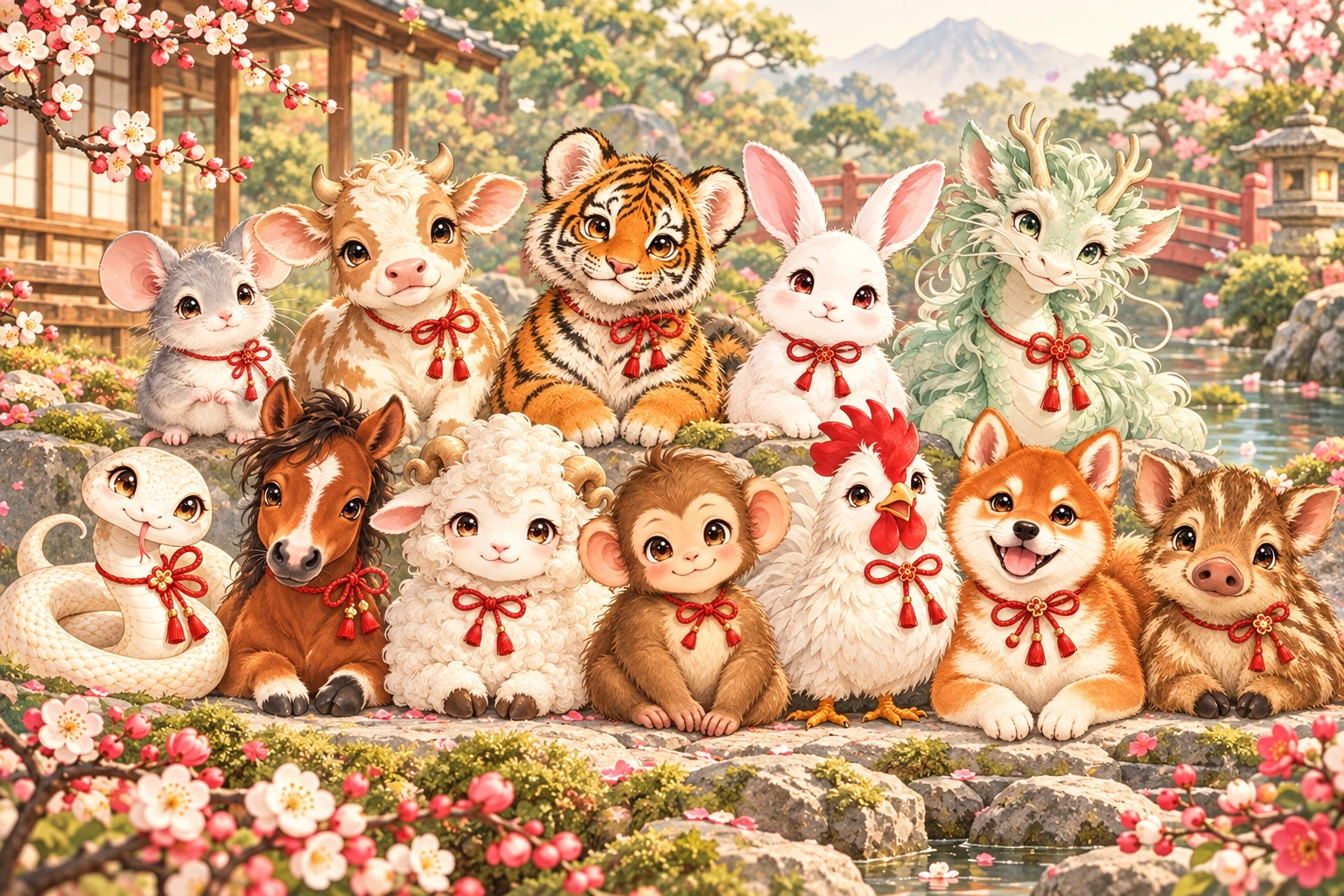
When someone says “I was born in the year of the Rabbit”, they are using the twelve signs, or jūnishi. Strictly speaking, eto means a cycle of sixty combinations: ten heavenly stems paired with the twelve earthly branches. In conversation, eto also means the animals. Let us meet the twelve companions, then their history and tales.
The twelve signs at a glance
First, here are the twelve animals in a table: order, reading, example years and traditional hours. 2026 is the year of the Horse (午, uma). In the full cycle of sixty combinations, it corresponds to hinoe-uma (丙午). Years run from 1900 to 2028, according to current Japanese usage (the year starting on 1 January).
| Sign | Animal | Years (1900–2028) | Hours |
|---|---|---|---|
| 1. 子 (ne) | Rat | 1900 1912 1924 1936 1948 1960 1972 1984 1996 2008 2020 | 11 pm–1 am |
| 2. 丑 (ushi) | Ox | 1901 1913 1925 1937 1949 1961 1973 1985 1997 2009 2021 | 1 am–3 am |
| 3. 寅 (tora) | Tiger | 1902 1914 1926 1938 1950 1962 1974 1986 1998 2010 2022 | 3 am–5 am |
| 4. 卯 (u) | Rabbit | 1903 1915 1927 1939 1951 1963 1975 1987 1999 2011 2023 | 5 am–7 am |
| 5. 辰 (tatsu) | Dragon | 1904 1916 1928 1940 1952 1964 1976 1988 2000 2012 2024 | 7 am–9 am |
| 6. 巳 (mi) | Snake | 1905 1917 1929 1941 1953 1965 1977 1989 2001 2013 2025 | 9 am–11 am |
| 7. 午 (uma) | Horse | 1906 1918 1930 1942 1954 1966 1978 1990 2002 2014 2026 | 11 am–1 pm |
| 8. 未 (hitsuji) | Sheep | 1907 1919 1931 1943 1955 1967 1979 1991 2003 2015 2027 | 1 pm–3 pm |
| 9. 申 (saru) | Monkey | 1908 1920 1932 1944 1956 1968 1980 1992 2004 2016 2028 | 3 pm–5 pm |
| 10. 酉 (tori) | Rooster | 1909 1921 1933 1945 1957 1969 1981 1993 2005 2017 | 5 pm–7 pm |
| 11. 戌 (inu) | Dog | 1910 1922 1934 1946 1958 1970 1982 1994 2006 2018 | 7 pm–9 pm |
| 12. 亥 (i) | Boar | 1911 1923 1935 1947 1959 1971 1983 1995 2007 2019 | 9 pm–11 pm |
1900s: 1900–1909
Find your animal by your year of birth. This table follows current Japanese usage: the year begins on 1 January.
| Year | Animal |
|---|---|
| 1900 | Rat |
| 1901 | Ox |
| 1902 | Tiger |
| 1903 | Rabbit |
| 1904 | Dragon |
| 1905 | Snake |
| 1906 | Horse |
| 1907 | Sheep |
| 1908 | Monkey |
| 1909 | Rooster |
1910s: 1910–1919
| Year | Animal |
|---|---|
| 1910 | Dog |
| 1911 | Boar |
| 1912 | Rat |
| 1913 | Ox |
| 1914 | Tiger |
| 1915 | Rabbit |
| 1916 | Dragon |
| 1917 | Snake |
| 1918 | Horse |
| 1919 | Sheep |
1920s: 1920–1929
| Year | Animal |
|---|---|
| 1920 | Monkey |
| 1921 | Rooster |
| 1922 | Dog |
| 1923 | Boar |
| 1924 | Rat |
| 1925 | Ox |
| 1926 | Tiger |
| 1927 | Rabbit |
| 1928 | Dragon |
| 1929 | Snake |
1930s: 1930–1939
| Year | Animal |
|---|---|
| 1930 | Horse |
| 1931 | Sheep |
| 1932 | Monkey |
| 1933 | Rooster |
| 1934 | Dog |
| 1935 | Boar |
| 1936 | Rat |
| 1937 | Ox |
| 1938 | Tiger |
| 1939 | Rabbit |
1940s: 1940–1949
| Year | Animal |
|---|---|
| 1940 | Dragon |
| 1941 | Snake |
| 1942 | Horse |
| 1943 | Sheep |
| 1944 | Monkey |
| 1945 | Rooster |
| 1946 | Dog |
| 1947 | Boar |
| 1948 | Rat |
| 1949 | Ox |
1950s: 1950–1959
| Year | Animal |
|---|---|
| 1950 | Tiger |
| 1951 | Rabbit |
| 1952 | Dragon |
| 1953 | Snake |
| 1954 | Horse |
| 1955 | Sheep |
| 1956 | Monkey |
| 1957 | Rooster |
| 1958 | Dog |
| 1959 | Boar |
1960s: 1960–1969
| Year | Animal |
|---|---|
| 1960 | Rat |
| 1961 | Ox |
| 1962 | Tiger |
| 1963 | Rabbit |
| 1964 | Dragon |
| 1965 | Snake |
| 1966 | Horse |
| 1967 | Sheep |
| 1968 | Monkey |
| 1969 | Rooster |
1970s: 1970–1979
| Year | Animal |
|---|---|
| 1970 | Dog |
| 1971 | Boar |
| 1972 | Rat |
| 1973 | Ox |
| 1974 | Tiger |
| 1975 | Rabbit |
| 1976 | Dragon |
| 1977 | Snake |
| 1978 | Horse |
| 1979 | Sheep |
1980s: 1980–1989
| Year | Animal |
|---|---|
| 1980 | Monkey |
| 1981 | Rooster |
| 1982 | Dog |
| 1983 | Boar |
| 1984 | Rat |
| 1985 | Ox |
| 1986 | Tiger |
| 1987 | Rabbit |
| 1988 | Dragon |
| 1989 | Snake |
1990s: 1990–1999
| Year | Animal |
|---|---|
| 1990 | Horse |
| 1991 | Sheep |
| 1992 | Monkey |
| 1993 | Rooster |
| 1994 | Dog |
| 1995 | Boar |
| 1996 | Rat |
| 1997 | Ox |
| 1998 | Tiger |
| 1999 | Rabbit |
2000s: 2000–2009
| Year | Animal |
|---|---|
| 2000 | Dragon |
| 2001 | Snake |
| 2002 | Horse |
| 2003 | Sheep |
| 2004 | Monkey |
| 2005 | Rooster |
| 2006 | Dog |
| 2007 | Boar |
| 2008 | Rat |
| 2009 | Ox |
2010s: 2010–2019
| Year | Animal |
|---|---|
| 2010 | Tiger |
| 2011 | Rabbit |
| 2012 | Dragon |
| 2013 | Snake |
| 2014 | Horse |
| 2015 | Sheep |
| 2016 | Monkey |
| 2017 | Rooster |
| 2018 | Dog |
| 2019 | Boar |
2020s: 2020–2029
| Year | Animal |
|---|---|
| 2020 | Rat |
| 2021 | Ox |
| 2022 | Tiger |
| 2023 | Rabbit |
| 2024 | Dragon |
| 2025 | Snake |
| 2026 | Horse |
| 2027 | Sheep |
| 2028 | Monkey |
| 2029 | Rooster |
The animals 1: Rat
small, quick and hard-working. Its many young make it a symbol of prosperous descendants. It is also said to be the messenger of Daikokuten, one of the seven gods of fortune.
The animals 2: Ox
a powerful animal that helped with work in the fields. Its slow, patient walk makes it a symbol of perseverance and sincerity. It is also the messenger of Tenjin, god of learning.
The animals 3: Tiger
strong and brave. According to the proverb “the tiger goes a thousand ri and returns a thousand ri”, it evokes momentum and, it is said, the return of money.
The animals 4: Rabbit
gentle and peaceful. Because it leaps, it evokes the “great leap” towards success. People also love the story of the rabbit pounding mochi on the Moon.
The animals 5: Dragon
the only imaginary animal among the twelve. It is seen as a deity that calls rain and water, a symbol of success and promotion.
The animals 6: Snake
it sheds its skin several times, hence the idea of rebirth and growth. The white snake is sometimes seen as the messenger of the goddess Benzaiten, associated with wealth.
The animals 7: Horse
a companion of humans in racing and work, synonymous with energy and drive. 午 means noon: it appears in “shōgo” (noon), “gozen” (morning) and “gogo” (afternoon).
The animals 8: Sheep
it lives peacefully in a flock. Its gentle, sociable image makes it a lucky charm for family safety and peace.
The animals 9: Monkey
intelligent and skilful. Because “saru” sounds like “to leave” (去る), it is used to wish that misfortunes go away.
The animals 10: Rooster
the bird that announces the morning. At the November Rooster Fair (“Tori no ichi”), people buy a decorative rake (kumade) to “rake in” good luck.
The animals 11: Dog
faithful to humans and guardian of the house. As female dogs are said to give birth easily, a pregnancy belt (haraobi) is tied on the Dog day of the fifth month of pregnancy, to wish for a peaceful birth.
The animals 12: Boar
it charges straight ahead (“chototsu mōshin”). Regarded as a lucky charm for good health, it is linked to the “Inoko” festival, where mochi is eaten on the Boar day to wish for health.
History: first a calendar system
The system developed in ancient China. Oracle inscriptions of the Shang period attest combinations of the ten stems and twelve branches used to count days. Originally it was not a personality horoscope based on little animals. The signs used to count time must be distinguished from their pairing with the animals.
In Japan: from calendar to daily life
Its transmission to Japan cannot be reduced to a single date. A sword from the Inariyama tumulus, generally dated to the 5th century, bears the mention of a “kanoto-i” year. The signs were also used to name hours and directions. Today, greeting cards and figurines honour the animal of the new year.
Why is kanreki celebrated at 60?
The two series advance together: one stem and one branch at each step. Their starting combination returns after sixty steps. So it is not a free choice among 10 × 12 possibilities. At 60, you meet the combination of your birth year again: this is the kanreki, the return to the initial cycle.
Traces in the Japanese language
The character of the sign is not that of the animal: the rat is written 鼠, but its branch is 子; the rabbit is written 兎, but its sign is 卯. The character 午 of gozen and gogo, before and after noon, refers to the hour of the Horse. The signs also served as landmarks: 子 for north, 午 for south, 卯 for east and 酉 for west.
Tale: the Rat on the Ox’s back
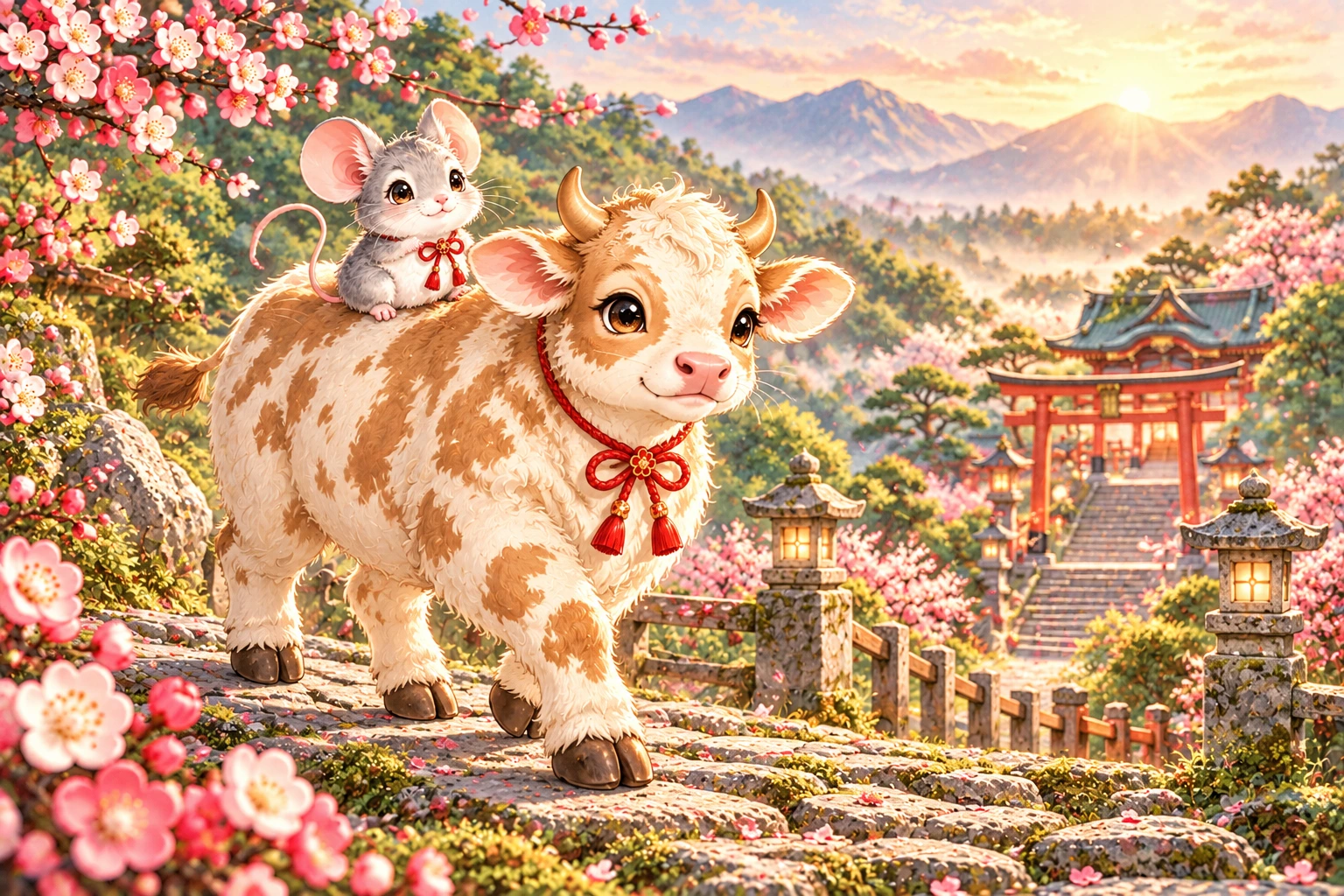
Here is a tale, not a historical document. A deity invites the animals and decides to entrust the years to them in order of arrival. The slow Ox leaves very early. The Rat travels on his back then jumps off just before the finish: he becomes first! The Ox is second, followed by the Tiger, Rabbit, Dragon, Snake, Horse, Sheep, Monkey, Rooster, Dog and Boar. Short adaptation by JAPANITIES.
Tale: why is the Cat missing?
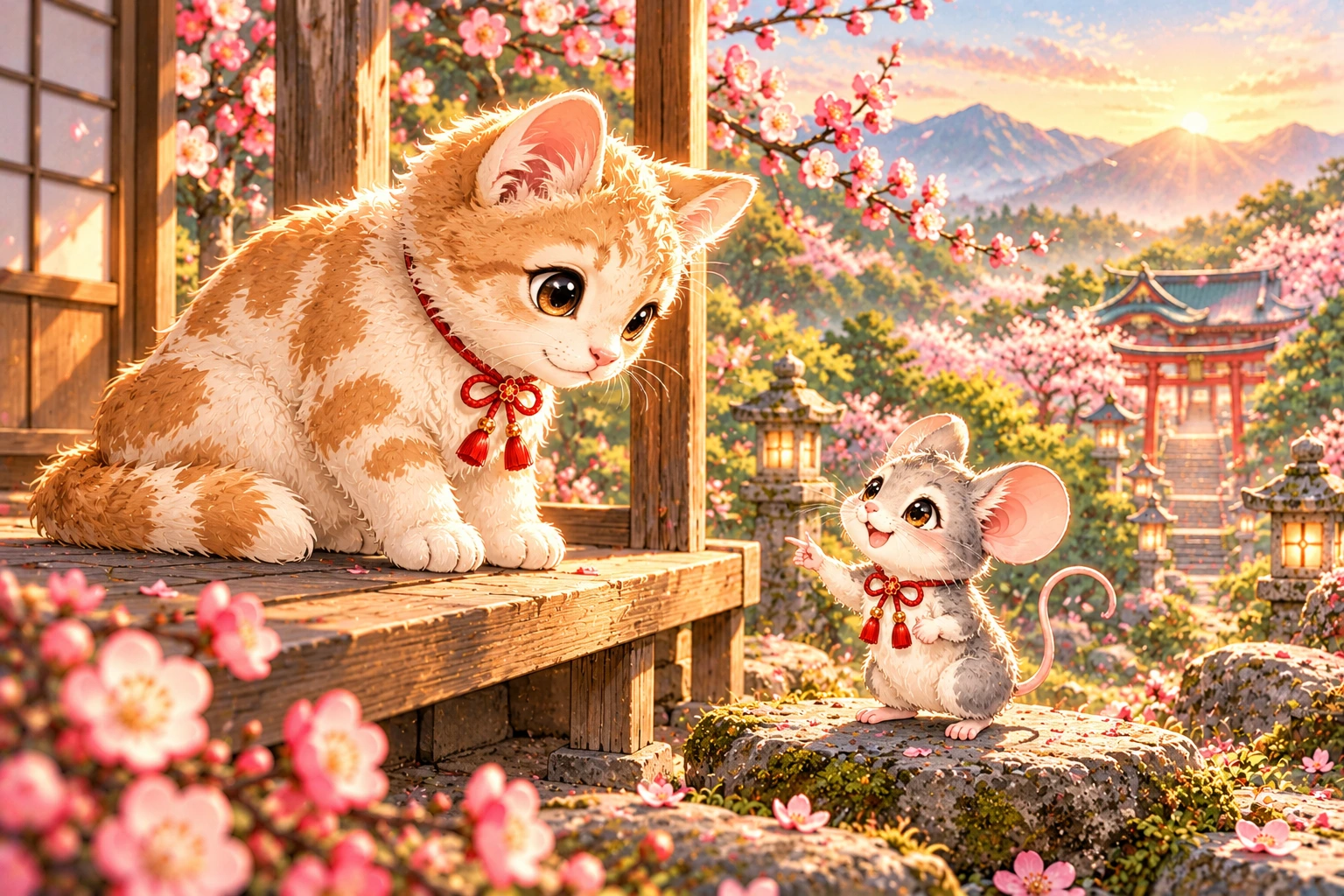
In one version, the Rat gives the Cat a false date, and the Cat arrives too late. Ever since, the Cat is said to chase the Rat. In an Okinawan account presented by the Nago museum, the Rat simply did not tell the Cat; the snake there is a habu, a local species. These differences show how tales travel. They are not proof, historically, of the Cat’s absence.
From one country to another: different animals
The cycle spread across several regions of Asia and adapted to local cultures. The Japanese Boar corresponds notably to the Chinese and Korean Pig; Vietnam has a Cat. The table shows some common differences, without claiming to sum up all local traditions.
| Country | Some differences |
|---|---|
| Japan | Rabbit and Boar; the eighth animal is generally called Sheep. |
| China | Rabbit and Pig; the eighth sign may be represented by a sheep or a goat. |
| South Korea | The Rabbit and the Pig appear in the cycle presented by the National Folk Museum. |
| Vietnam | The Cat replaces the Rabbit, and the Water Buffalo replaces the Ox. |
The boundary between years matters
In current Japanese usage, the change happens on 1 January. In traditions that follow the lunar New Year, a person born between these two dates may fall under another animal. Some schools of divination use the start of spring as the boundary. To compare countries, you therefore need to specify the calendar and the convention, not just the calendar year.
And Western zodiac signs?
The Japanese or Chinese zodiac is not the same as Western signs such as Aries or Taurus. In common usage, the latter depend on the day and month of birth, whereas the twelve animals presented here follow the years. To avoid ambiguity, ask: “What is your Japanese zodiac sign?”
Find your animal and set it as your icon in My JAPANITIES
In My JAPANITIES you will find these twelve animals as profile icons. First look up your animal in the table above: for example, 2026, 2014 and 2002 are years of the Horse. Then choose your animal’s icon in My JAPANITIES. You can also simply take your favourite animal. It is a way to discover a culture, without reducing a person to a sign.
Learn the grammar
French grammar
Learn sentence patterns and usage from the article’s own sentences.
01The present indicative
est / sont + attribute (noun, adjective, prepositional phrase)
Il est aussi le messager de Tenjin, dieu des études.Key pointsÊtre in the present is est for a singular subject and sont for a plural one. It describes nature, state or place (“is”, “is located”). If what follows (the attribute) is a noun, adjective or prepositional phrase, it is not a passive. If a past participle follows, it is a passive (est annoncé). Headlines and summaries often use the present to describe the current situation.
02The passé composé
present of avoir + past participle
Les signes ont également servi à désigner les heures et les directions.Key pointsThe passé composé is the most common past tense, used for “did” and “has done” — actions completed in the past. It is formed with the auxiliary avoir (a / ont…) in the present + a past participle. Past participles of -er verbs end in -é (annoncer → annoncé); learn the irregular ones (faire → fait, prendre → pris, voir → vu). In the negative, ne … pas wraps the auxiliary (n’a pas annoncé). In the news it reports facts that have already happened, such as “announced” or “voted”.
03The passé composé of pronominal verbs
se + present of être + past participle
Le système s’est développé dans la Chine ancienne.Key pointsThe passé composé of a pronominal verb (se + verb) always uses être as auxiliary (il s’est diffusé / elles se sont réunies). Se changes with the subject: me, te, se, nous, vous. The past participle usually agrees with the subject in gender and number.
04The imparfait
stem (nous form of the present) + -ais / -ait / -ions / -iez / -aient
un animal puissant qui aidait aux travaux des champs.Key pointsThe imparfait describes states, background, habits and actions in progress in the past (il était, elle avait, ils pensaient). Take the nous form of the present, drop -ons, and add -ais / -ais / -ait / -ions / -iez / -aient. If the passé composé gives “the event itself”, the imparfait paints “the situation at the time”.
05The futur simple
stem (infinitive) + -ai / -as / -a / -ons / -ez / -ont
Dans My JAPANITIES, vous trouverez ces douze animaux comme icônes de profil.Key pointsThe futur simple means “will do” or “is planned to”. Add -ai, -as, -a, -ons, -ez, -ont to the infinitive (participer → il participera). Watch the irregular stems: être → ser-, avoir → aur-, aller → ir-, faire → fer-, pouvoir → pourr-, voir → verr-. In the news it is used for fixed plans and outlooks.
06The present conditional
stem (infinitive) + -ais / -ait / -ions / -iez / -aient
Depuis, le Chat poursuivrait le Rat.Key pointsThe conditional expresses possibility, supposition, unconfirmed information and polite requests (“would”, “might”). It uses the same stem as the future and the same endings as the imparfait (-ais, -ait, -ions, -iez, -aient): pouvoir → il pourrait. In the news it is used to avoid asserting, as in “is reported to…” or “there is a possibility…”.
07The present subjunctive
il faut que / pour que / bien que + subject + subjunctive
Comme « saru » se prononce comme « partir » (去る), il sert à souhaiter que les malheurs s’éloignent.Key pointsThe subjunctive expresses wish, need, purpose, doubt and feeling rather than “fact”. It is used inside a clause with que. Triggers: il faut que (must), pour que / afin que (so that), bien que / quoique (although), avant que (before), souhaiter que, vouloir que and others. Formation: stem of the ils present minus -ent + -e, -es, -e, -ions, -iez, -ent. Irregular: être → soit, avoir → ait, aller → aille, faire → fasse, pouvoir → puisse, savoir → sache.
08The passive voice in the present
être (est / sont) + past participle (+ par / de)
2026 est l’année du Cheval (午, uma).Key pointsThe passive means “is done” or “is being done”. It is formed with être + past participle, which agrees with the subject in gender and number (la mesure est adoptée / les mesures sont adoptées). The agent is introduced by par (or de). In the news it is common when the event, rather than the actor, is the focus (est prévu / est annoncé / est connu).
09The imperative
present vous form (-ez) / nous (-ons) / tu
Retrouvez votre animal selon votre année de naissance.Key pointsThe imperative expresses commands, requests and advice. It has no subject: the sentence starts with the verb (Consultez les informations.). The vous form ends in -ez, nous in -ons (Restons prudents.), and tu in -e for -er verbs (Consulte). It is very common in notices and warnings (Vérifiez, Consultez, Restez informé).
10Pronominal verbs
se / s’ + verb
Il ne s’agissait pas, à l’origine, d’un horoscope de personnalité fondé sur de petits animaux.Key pointsA pronominal verb is used with a reflexive pronoun (me, te, se, nous, vous) before the verb. It can mean “do to oneself”, “be done” or “do to each other”. In the news, se traduire (to result in), se tenir (to take place), s’agir de (to be a matter of) and se diffuser (to spread) are frequent. The pronoun changes with the subject (il se tient / ils se tiennent / je me souviens).
11Negation and its scope
ne / n’ … pas · ne … plus
Il ne s’agissait pas, à l’origine, d’un horoscope de personnalité fondé sur de petits animaux.Key pointsNormally ne and pas wrap the verb. Before a vowel, ne becomes n’. Check which part of the sentence the negation covers. Ne … plus means “no longer”.
12Citing a source with selon
selon + noun / organisation
Les années vont de 1900 à 2028, selon l’usage japonais courant (début d’année au 1er janvier).Key pointsSelon means “according to”. Put a person or organisation after it as the source. It separates facts the writer checked directly from what another body or report said. Citing a source does not turn a forecast into an accomplished fact.
13Pouvoir: ability and possibility
peut / peuvent / pourrait + infinitive
On ne peut pas réduire sa transmission au Japon à une date unique.Key pointsPut a base-form verb after pouvoir. Peut means “can” or “may”; the conditional pourrait gives a more reserved possibility, “might”. It does not necessarily mean implementation is settled.
14Purpose with pour
pour + infinitive
Les accouchements des chiennes étant réputés faciles, on noue une ceinture de grossesse (haraobi) le jour du Chien du cinquième mois de grossesse, pour souhaiter un accouchement paisible.Key pointsThis is the purpose, “in order to…”. Put the base form of a verb after pour. The purpose stated here is separate from whether the effect was actually achieved.
15The construction il s’agit de
il s’agit de + noun / infinitive
Il ne s’agit donc pas de choisir librement parmi 10 × 12 possibilités.Key pointsIt explains what something is about: “it is a matter of…”. The il is not a particular man but a formal subject of this construction. The negative il ne s’agit pas de means “this is not about…”.
Japanese grammar
Understand the structure and usage from the text.
01Rejecting an interpretation
〜わけではない / 〜という意味ではない
最初から、かわいい動物の性格占いだったわけではありません。Key pointsThese forms limit and deny an interpretation: “it does not necessarily follow” or “that is not what is meant”. They do not necessarily deny every fact in the sentence. Read what is being denied together with the earlier part.
02Polite negation and plain form
〜ではありません / 〜ではない
10×12=120通りを自由に組み合わせる方式ではありません。Key pointsThey negate a noun and similar content. “ではありません” is the polite form and “ではない” the plain form. “成立ではありません” shows that it cannot be said to have been concluded.
03Cause or purpose with ため
〜ため / 〜ために
殷代の甲骨文には、日を数えるための十干十二支の組み合わせが見られます。Key pointsため is used for both reason and purpose. “成立ではないため” is a reason and “運転手を守るため” a purpose. Decide from the whole sentence whether what precedes is a cause or a goal.
04Giving examples with など
noun / expression + など
十二支は東アジアなどに広まり、地域の動物や文化と結び付きました。Key points“暴言など” gives “abusive language” as one example. It is not necessarily a closed list of only the things named. It also helps when reading the scope of a news story.
05The polite past ました
verb stem (連用形) + ました
干支の仕組みは古代中国で発達しました。Key pointsIn “発表しました”, ました makes a verb polite past. The negative is “ませんでした”. Read the actual date together with the date and time in the text.
06Quoting with と: content and report
plain-form sentence + と + verbe de parole (報じる, 説明する…)
子どもがたくさん生まれることから、「子孫繁栄」の縁起のよい動物とされています。Key pointsと takes the content that is reported or explained. In “改定する方針だと報じました”, “改定する方針だ” is what the report said. Separating the content from who said it and how makes long sentences easier to read.