Mizuhiki: the meaning of knots and colours, its history, and the JAPANITIES logo
Checked on
Published on
The history of mizuhiki, the meaning of the knots (musubi-kiri, awaji, butterfly, ume) and colours, the production regions, and why we chose mizuhiki for the JAPANITIES logo.
In this article
The essentials
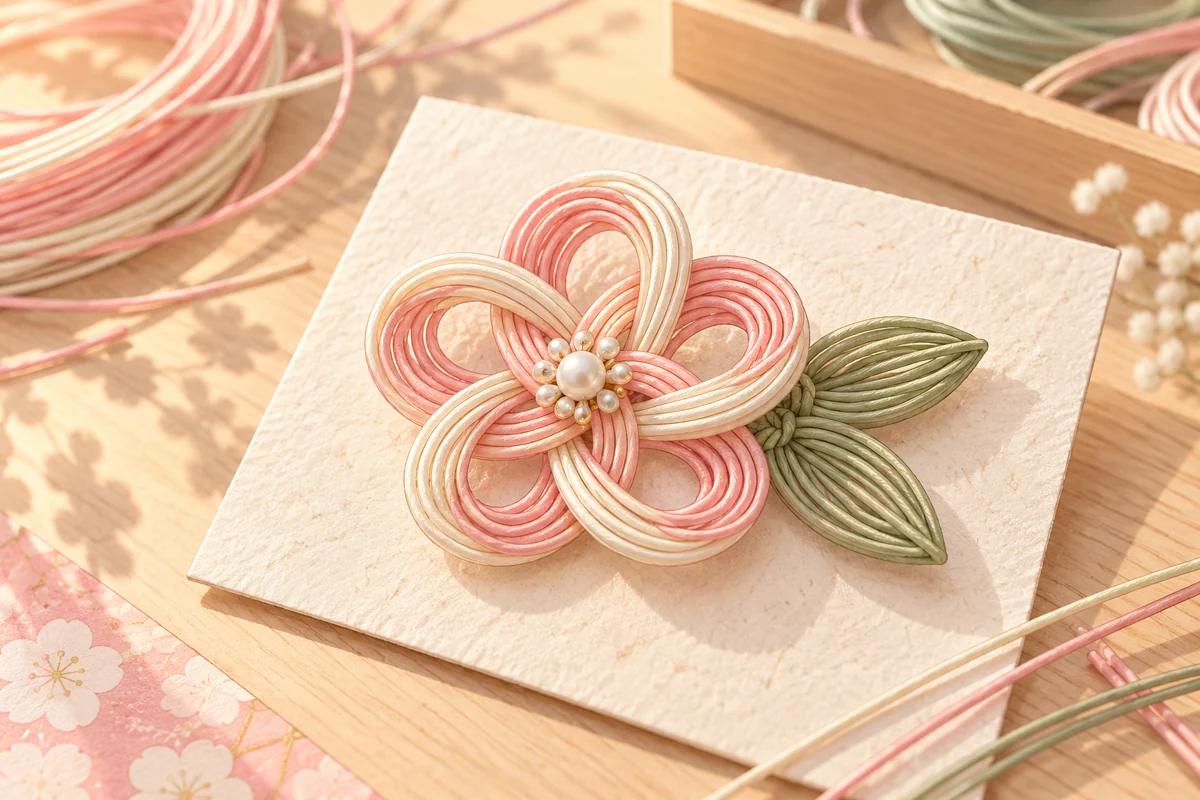
Mizuhiki is a cord made of thin strips of Japanese paper (washi) twisted, then hardened with glue. Several are assembled and tied into beautiful patterns. In Japan it is used for weddings, birth gifts, New Year and presents. Today it also appears in jewellery and decoration.
What mizuhiki expresses
Mizuhiki mainly carries the following values. “En” (縁) is the bond between people; “musubi” (knot), care for the relationship; “blessing”, the wish for the other’s happiness; “thoughtfulness”, the feelings put into a gift. It also expresses Japanese tradition and aesthetic sense, which draw beauty from very fine lines.
History
The origins of mizuhiki are the subject of several theories. One says that at the beginning of the 7th century, when Ono no Imoko returned from Sui China, a gift was tied with a hemp cord dyed half red and half white. In the middle of the Heian period, paper cords began to be used. From the Muromachi period, the “motoyui”, which ties the hair, was distinguished from mizuhiki reserved for gifts; it spread as a decoration unique to Japan, made of washi paper.
Modern developments
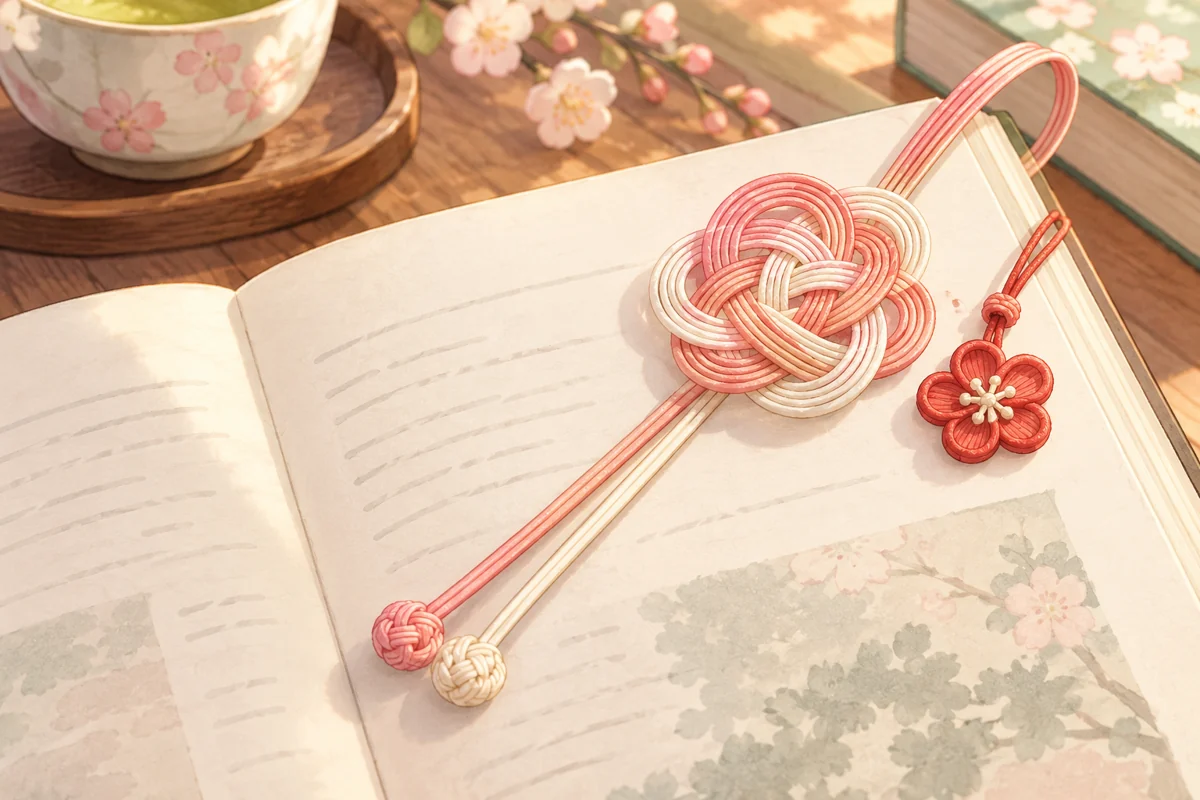
In the Meiji era, the edict banning the topknot reduced demand for motoyui, and makers turned to mizuhiki. In 1916, Tsuda Sōkichi devised the “Tsuda-shiki mizuhiki orikata”, which allowed the development of three-dimensional mizuhiki objects. It is said that this culture has lasted about 1,400 years, but that figure depends on the theory adopted about the origins.
The most common knots
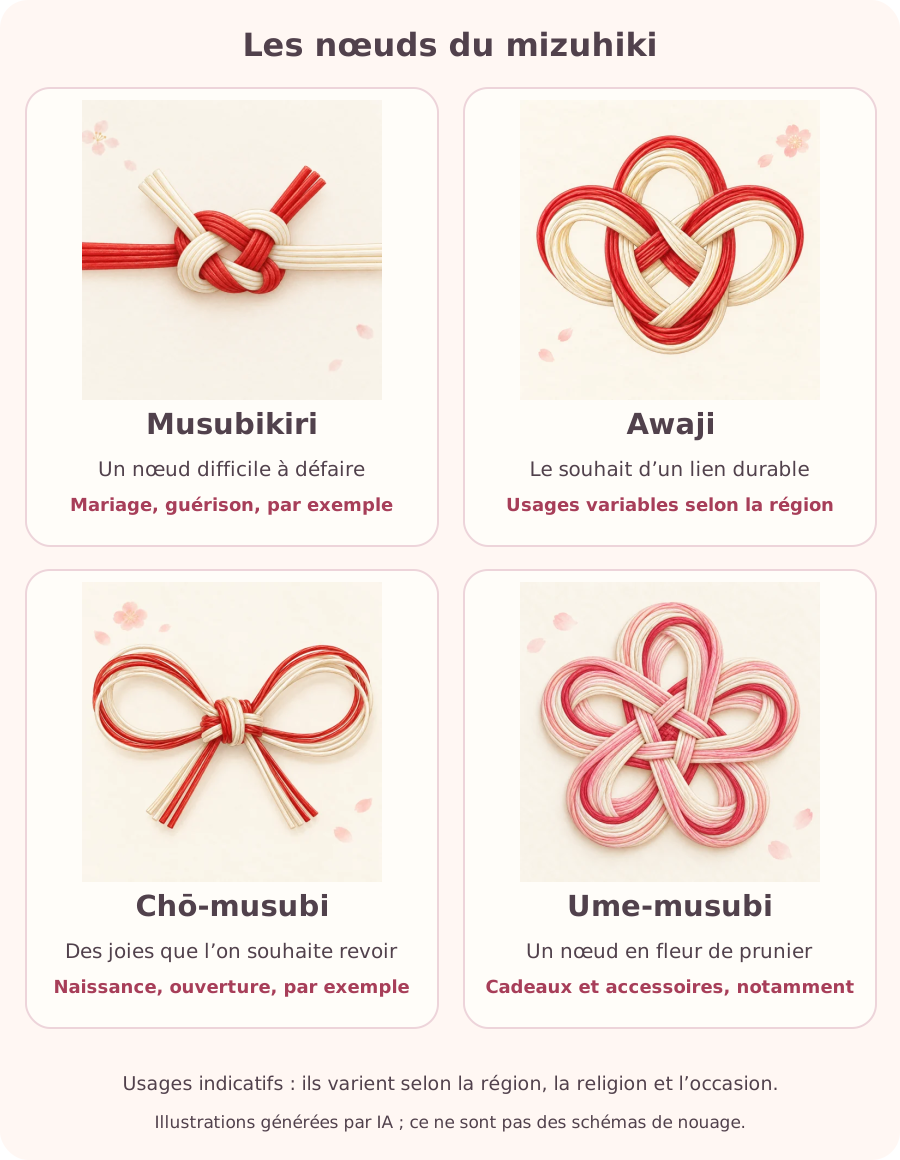
The “musubi-kiri” is a knot that is hard to undo, used for weddings and condolences. The “awaji-musubi”, a variant of the musubi-kiri, tightens when you pull both ends; it symbolises a lasting bond. The “chō-musubi” (bow knot) can be redone at will: it is used for happy events that can be repeated, such as a birth or the opening of a business. The “ume-musubi” is inspired by the plum blossom that opens after the cold winter; it carries the wish for a strong bond and good fortune. Interpretation varies by region and custom.
The meaning of colours
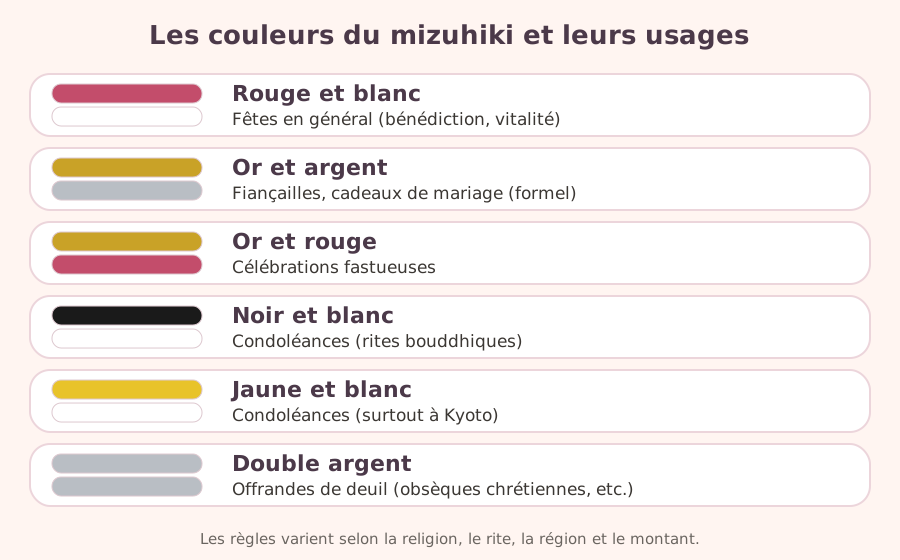
“Red and white” is used for celebrations in general and expresses blessing and vitality. “Gold and silver” is reserved for more formal ceremonies, such as engagements or wedding gifts. “Gold and red” suits lavish celebrations. For condolences, “black and white” is used, and in some regions “yellow and white”. “Double silver” is sometimes used for offerings at Christian funerals. The colour rules vary with religion, rite, region and amount.
The main production regions
The well-known regions are “Iida mizuhiki” (Iida, Nagano), “Iyo mizuhiki” (Shikokuchūō, Ehime) and “Kaga mizuhiki” (Kanazawa, Ishikawa). In Iida, they moved from motoyui to mizuhiki. Kaga took up the Tsuda-shiki orikata and is regarded as the cradle of three-dimensional mizuhiki.
The JAPANITIES logo and mizuhiki

The JAPANITIES logo is inspired by the “ume-musubi” in mizuhiki. This traditional Japanese craft lets us express our wish to link the cultures of Japan and France: the crossing lines evoke the meeting of different cultures; the pattern drawn in a single stroke, a bond that goes beyond borders; the plum blossom, the spirit of Japan and a new start; the delicate curves, the Japanese aesthetic sense and the artisans’ skill.
To keep in mind
The origins of mizuhiki are the subject of several theories and the dates are partly a matter of tradition. The meaning of knots and colours varies with region, religion and occasion. That of the “ume-musubi” is an interpretation that differs between regions. When choosing a mizuhiki, check the occasion and local customs.
Learn the grammar
French grammar
Learn sentence patterns and usage from the article’s own sentences.
01The present indicative
est / sont + attribute (noun, adjective, prepositional phrase)
Le mizuhiki est un cordon fait de fines bandes de papier japonais (washi) tordues, puis durcies à la colle.Key pointsÊtre in the present is est for a singular subject and sont for a plural one. It describes nature, state or place (“is”, “is located”). If what follows (the attribute) is a noun, adjective or prepositional phrase, it is not a passive. If a past participle follows, it is a passive (est annoncé). Headlines and summaries often use the present to describe the current situation.
02The passé composé
present of avoir + past participle
L’histoire du mizuhiki, le sens des nœuds (musubi-kiri, awaji, papillon, ume) et des couleurs, les régions de production, et pourquoi nous avons choisi le mizuhiki pour le logo de JAPANITIES.Key pointsThe passé composé is the most common past tense, used for “did” and “has done” — actions completed in the past. It is formed with the auxiliary avoir (a / ont…) in the present + a past participle. Past participles of -er verbs end in -é (annoncer → annoncé); learn the irregular ones (faire → fait, prendre → pris, voir → vu). In the negative, ne … pas wraps the auxiliary (n’a pas annoncé). In the news it reports facts that have already happened, such as “announced” or “voted”.
03The passé composé of pronominal verbs
se + present of être + past participle
À partir de l’époque de Muromachi, on a distingué le « motoyui », qui attache les cheveux, du mizuhiki réservé aux cadeaux ; il s’est répandu comme une décoration propre au Japon, faite de papier washi.Key pointsThe passé composé of a pronominal verb (se + verb) always uses être as auxiliary (il s’est diffusé / elles se sont réunies). Se changes with the subject: me, te, se, nous, vous. The past participle usually agrees with the subject in gender and number.
04The imparfait
stem (nous form of the present) + -ais / -ait / -ions / -iez / -aient
L’une d’elles dit qu’au début du VIIe siècle, au retour d’Ono no Imoko de la Chine des Sui, un cadeau était noué d’une corde de chanvre teinte moitié rouge, moitié blanche.Key pointsThe imparfait describes states, background, habits and actions in progress in the past (il était, elle avait, ils pensaient). Take the nous form of the present, drop -ons, and add -ais / -ais / -ait / -ions / -iez / -aient. If the passé composé gives “the event itself”, the imparfait paints “the situation at the time”.
05The passive voice in the present
être (est / sont) + past participle (+ par / de)
L’une d’elles dit qu’au début du VIIe siècle, au retour d’Ono no Imoko de la Chine des Sui, un cadeau était noué d’une corde de chanvre teinte moitié rouge, moitié blanche.Key pointsThe passive means “is done” or “is being done”. It is formed with être + past participle, which agrees with the subject in gender and number (la mesure est adoptée / les mesures sont adoptées). The agent is introduced by par (or de). In the news it is common when the event, rather than the actor, is the focus (est prévu / est annoncé / est connu).
06Pronominal verbs
se / s’ + verb
Le « awaji-musubi », variante du musubi-kiri, se resserre quand on tire sur les deux bouts ; il symbolise un lien durable.Key pointsA pronominal verb is used with a reflexive pronoun (me, te, se, nous, vous) before the verb. It can mean “do to oneself”, “be done” or “do to each other”. In the news, se traduire (to result in), se tenir (to take place), s’agir de (to be a matter of) and se diffuser (to spread) are frequent. The pronoun changes with the subject (il se tient / ils se tiennent / je me souviens).
07Citing a source with selon
selon + noun / organisation
L’interprétation varie selon les régions et les usages.Key pointsSelon means “according to”. Put a person or organisation after it as the source. It separates facts the writer checked directly from what another body or report said. Citing a source does not turn a forecast into an accomplished fact.
08Pouvoir: ability and possibility
peut / peuvent / pourrait + infinitive
Le « chō-musubi » (nœud papillon) se refait à volonté : on l’emploie pour les heureux événements qui peuvent se répéter, comme une naissance ou l’ouverture d’un commerce.Key pointsPut a base-form verb after pouvoir. Peut means “can” or “may”; the conditional pourrait gives a more reserved possibility, “might”. It does not necessarily mean implementation is settled.
09The subject relative pronoun qui
noun + qui + verb
Il traduit aussi la tradition et le sens esthétique japonais, qui tirent la beauté de lignes très fines.Key pointsQui continues a description of the person or thing just mentioned (“the one that does…”). Because qui is itself the subject of the next verb, do not repeat the subject. The verb agrees with the noun qui refers to.
10Marking a starting point
dès / depuis / à partir de + point in time
À partir de l’époque de Muromachi, on a distingué le « motoyui », qui attache les cheveux, du mizuhiki réservé aux cadeaux ; il s’est répandu comme une décoration propre au Japon, faite de papier washi.Key pointsDès means “as early as” or “as soon as”, and à partir de means “from … onwards”. Depuis basically shows a state or period continuing from a point in time. All deal with a start, but they are not used the same way.
11Marking an opposition or a reservation
mais / cependant / toutefois / en revanche
On dit que cette culture dure depuis environ 1 400 ans, mais ce chiffre dépend de la théorie retenue sur les origines.Key pointsThese continue with something that contrasts with the preceding content, or a reservation to note. Mais is the widely usable “but” and en revanche stresses the contrast. After the connector, information may come that corrects the first impression.
Japanese grammar
Understand the structure and usage from the text.
01Cause or purpose with ため
〜ため / 〜ために
「あわじ結び」は、結び切りの一種で、両端を引くと強く結ばれるため、末永い縁をあらわします。Key pointsため is used for both reason and purpose. “成立ではないため” is a reason and “運転手を守るため” a purpose. Decide from the whole sentence whether what precedes is a cause or a goal.
02Giving examples with など
noun / expression + など
日本では、結婚式、出産のお祝い、お正月、贈り物などに使われます。Key points“暴言など” gives “abusive language” as one example. It is not necessarily a closed list of only the things named. It also helps when reading the scope of a news story.
03The polite past ました
verb stem (連用形) + ました
平安時代の中ごろには、紙のひもが使われるようになりました。Key pointsIn “発表しました”, ました makes a verb polite past. The negative is “ませんでした”. Read the actual date together with the date and time in the text.
04Treating a clause like a noun with こと
plain-form sentence + こと + particle
キリスト教式の香典には、「双銀」が使われることがあります。Key points“〜すること” treats an action or content like a noun. The particle after it (が・を・は…) shows its role in the sentence. “ことができる” is a fixed combination meaning “can”.
05Linking actions with the て-form
verb て-form + next expression
水引の歴史、結び切り・あわじ結び・蝶結び・梅結びの意味、色の意味、産地、そしてJAPANITIESのロゴに水引を選んだ理由。Key pointsThe て-form links actions in a series, in order or as a reason. In “確認して、出発する” the relation is judged from the content. In “〜ている” it can show an action in progress or a continuing state.
06Linking two nouns with の
noun A + の + noun B
「結び」は、関係を大切にすること、「祝福」は、相手の幸せを願うことです。Key pointsA explains noun B that follows. It is not only possession: the relation can be belonging, target, content and more. In “政府の案” and “年金の税控除”, read the relation from the context.