The way of tea (chanoyu): history, schools, utensils and how it unfolds
Checked on
Published on
The history of the way of tea, the schools (the three Sen houses), koicha and usucha, the utensils, the difference between chaji and chakai. With a ceremony to experience in Bordeaux.
In this article
The essentials
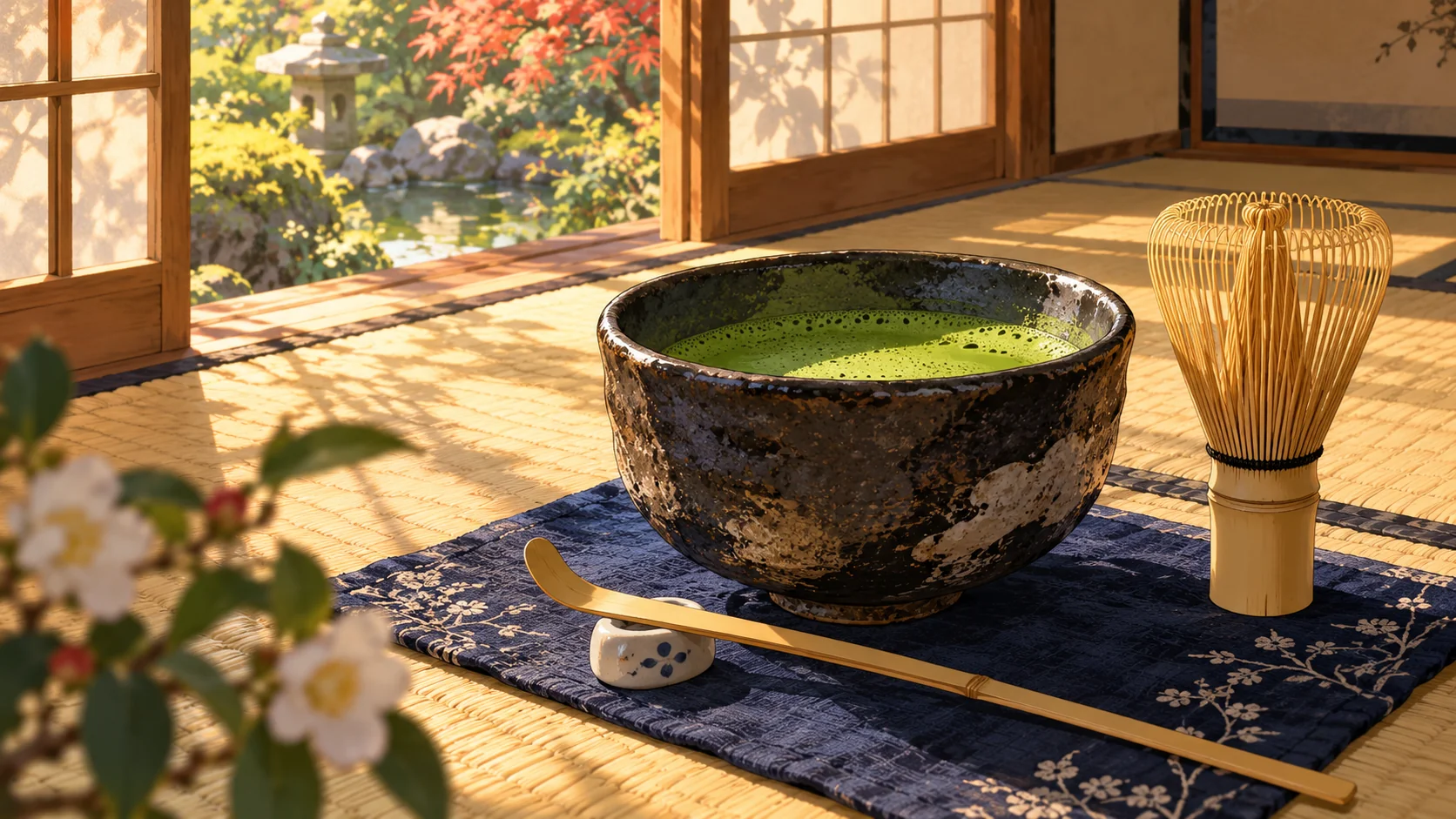
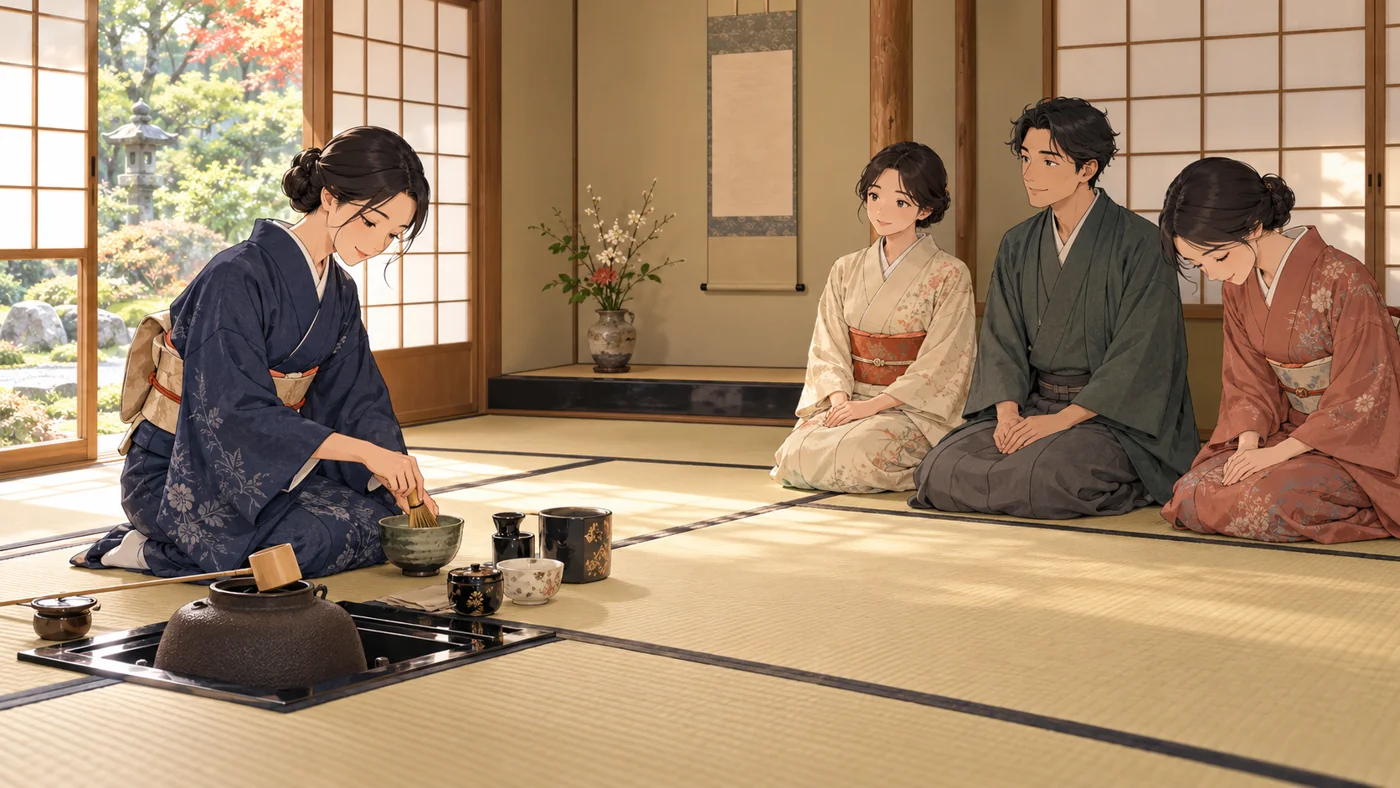
The way of tea (chanoyu, sadō or chadō) is a traditional Japanese art: water is heated, powdered tea (matcha) is whisked and served to guests. It is not only about drinking tea; host and guests share a moment where hearts meet. This article traces the history, the schools, the utensils and the types of gatherings, in Japanese, French and English.
The name and its reading
Originally, people spoke of “chanoyu” (茶湯). Sen no Rikyū called it “sukidō”. It was Kobori Enshū who spoke of the “way of tea”; the character “way” (道) then spread, and in the second half of the 17th century “茶道” was also used. Schools such as the Omotesenke read it “sadō”, whereas the Urasenke reads it “chadō”.
History
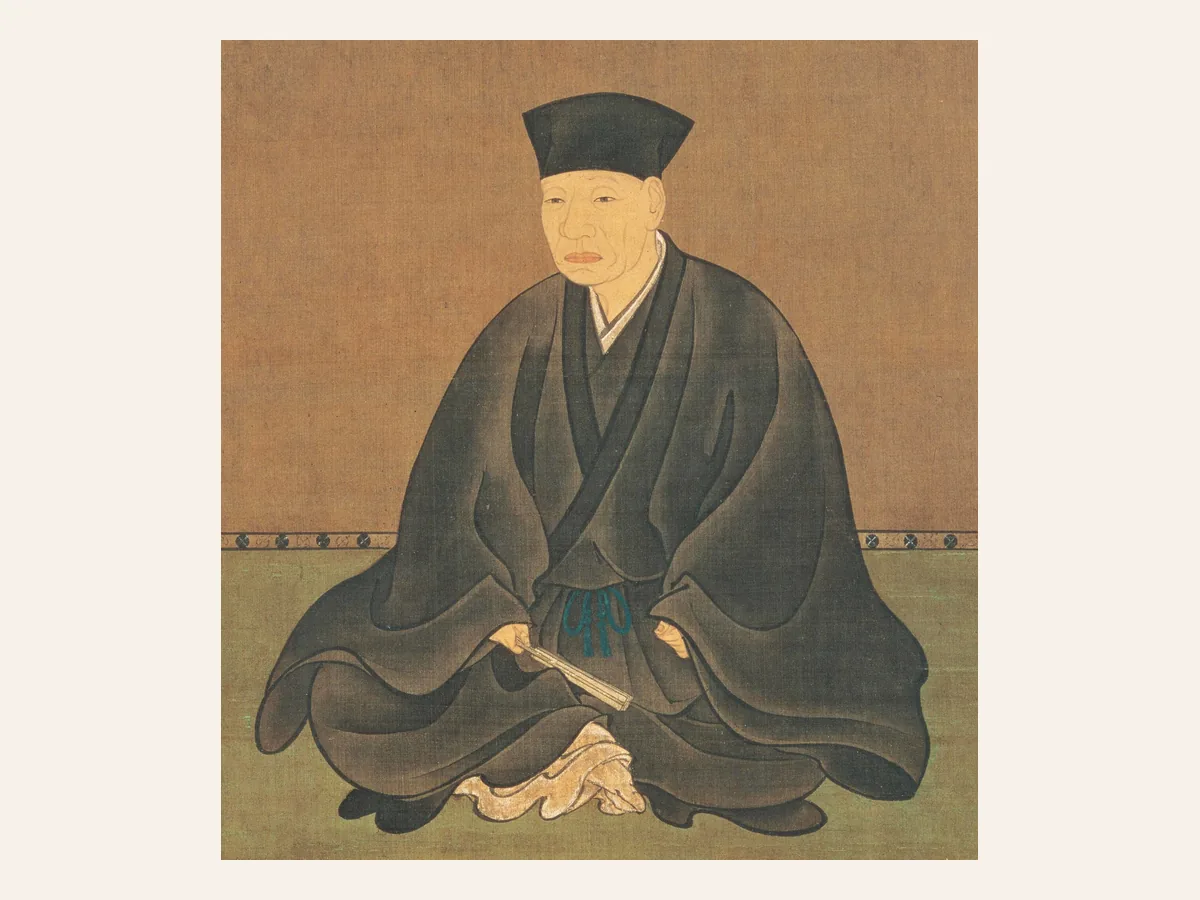
It is said that in 1168 the monk Eisai planted on Mount Sefuri tea seeds brought from China (Song dynasty). In 1214, he offered the shogun Minamoto no Sanetomo his book “Kissa yōjōki”. At the end of the 15th century, Murata Jukō advocated gatherings based on spiritual exchange, the source of “wabi-cha”. In the Azuchi-Momoyama period, after Takeno Jōō, Sen no Rikyū perfected wabi-cha. In 1587, Toyotomi Hideyoshi organised the great Kitano tea ceremony.
From the Edo period to today
In the Edo period, the system of hereditary masters (iemoto) was organised around the three Sen houses. It is also in this period that the expression “wa kei sei jaku” (harmony, respect, purity, tranquillity) was born. In 1906, Okakura Kakuzō (Tenshin) published “The Book of Tea” in English. Thanks to this book, the way of tea became known abroad.
The three Sen houses
After Sen no Rikyū’s death, the way of tea passed to his son Shōan, then to his grandson Sōtan, who settled in Kyoto. His sons founded three houses: the third son, Kōshin Sōsa, took over the main house, the “Omotesenke”; the second, Ichiō Sōshu, founded the “Mushakōjisenke”; the fourth, Sensō Sōshitsu, founded the “Urasenke”. These three houses form the “san-senke”.
The Omotesenke
The Omotesenke is the main house of the Sen. Its name comes from the fact that the “Konnichian” of the junior branch Urasenke lies behind the “Fushin’an” of the Omotesenke. Its emblematic tea room is the Fushin’an, whose name draws on the phrase “Fushin hana hiraku konnichi no haru”. In 1642, the 4th master, Kōshin, entered the service of the Kishū domain; until Meiji, successive masters were tea masters of the Tokugawa family of Kishū. In the time of the 7th master, Nyoshinsai, the pyramid organisation around the iemoto was established, and the group exercises of the “shichiji-shiki” enjoyed great success. The current master is the 15th, Yūyūsai Sen Sōsa.
The Urasenke
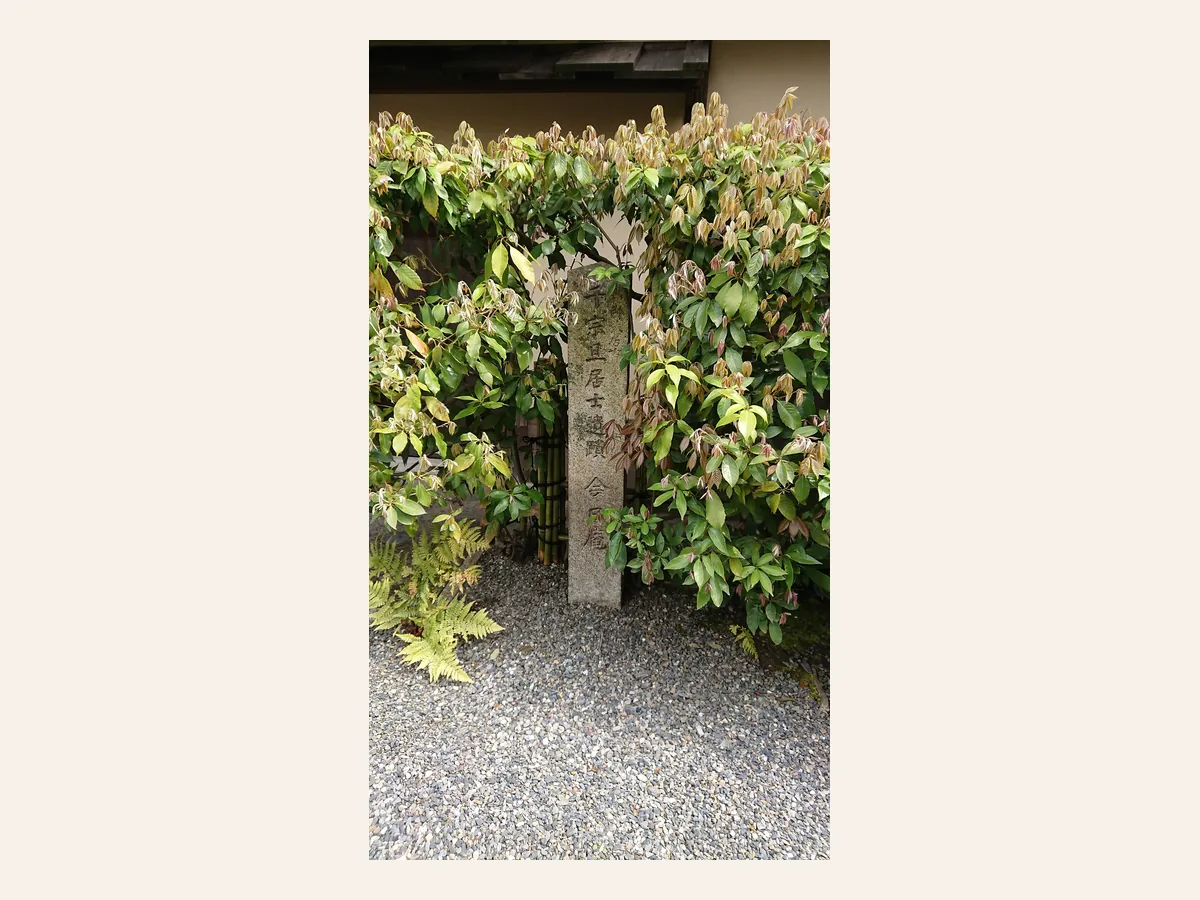
The Urasenke is known for its tea room “Konnichian”. It arose when Sōtan, on retiring, handed all his tea rooms to his fourth son Sensō Sōshitsu. The gestures of the three houses are essentially similar, but at the Urasenke the light tea is whisked into a frothy foam, the whisk is of white bamboo, and the sweets box is a bowl without a lid. The 11th master, Gengensai, is said to have devised the “ryūrei”, table service, on the occasion of the Meiji 5 (1872) exhibition, to receive foreigners. The 14th, Tantansai, pushed the introduction of the way of tea into school education, and the 15th, Hōunsai, devoted himself to spreading it abroad. It is said to be the school with the most practitioners; the current master is the 16th, Gen’mokusōshitsu (Zabōsai).
The Mushakōjisenke
The Mushakōjisenke was founded by Ichiō Sōshu; its name comes from Mushakōji Street in Kyoto, where the master’s house stands. Its tea room is the “Kankyūan”. The decoration of the room is more sober than in the other schools, and at a chaji economical and rational gestures are preferred. It is said to be, among the three houses, the school with the calmest and most refined impression.
Schools that came from the samurai world
Other schools developed among warriors. The “Enshū” school was founded by Kobori Enshū, tea master to the 3rd Tokugawa shogun Iemitsu; it values “kirei-sabi”, a wabi-sabi to which harmonious beauty is added. The “Oribe” school was founded by Furuta Oribe, one of Rikyū’s seven disciples. The “Sekishū” school was founded by Katagiri Sekishū, and the “Uraku” school by Oda Uraku. There are also the “Sōwa” school of Kanamori Sōwa, the “Yabunouchi” school of Yabunouchi Kenchū, the “Ueda Sōko” school of Ueda Sōko, and the “Edo Senke” of Kawakami Fuhaku.
Thick tea and thin tea

“Koicha” (thick tea) is prepared with plenty of matcha and little water: it is “kneaded”. The guests drink in turn from a single bowl. “Usucha” (thin tea) contains less matcha and is “whisked” to make foam; each guest receives their own bowl. At large gatherings, usucha is often served.
The utensils
For a ceremony, the following are used: bowls (chawan), tea caddies (chaire), scoops (chashaku), natsume, a kettle (kama), a water jar (mizusashi), a waste-water bowl (kensui), an incense container (kōgō), and so on. Matcha is whisked with a bamboo whisk (chasen). The water is heated on a sunken hearth (ro) in winter and on a portable brazier (furo) in summer.
Kaiseki (the meal)
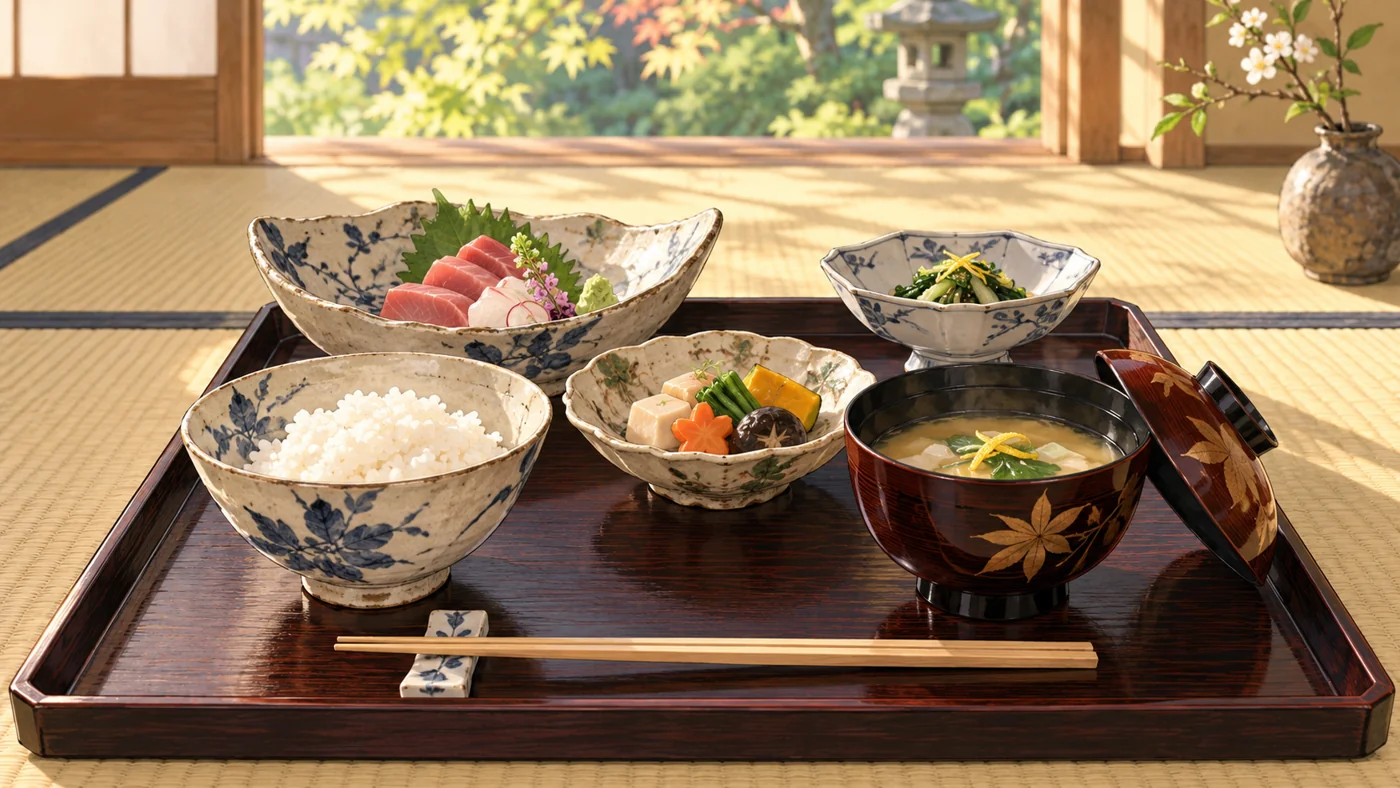
“Kaiseki” is the simple meal served at a chaji. The chaji, a formal ceremony with kaiseki, lets you taste both the meal and the tea.
Chaji and chakai
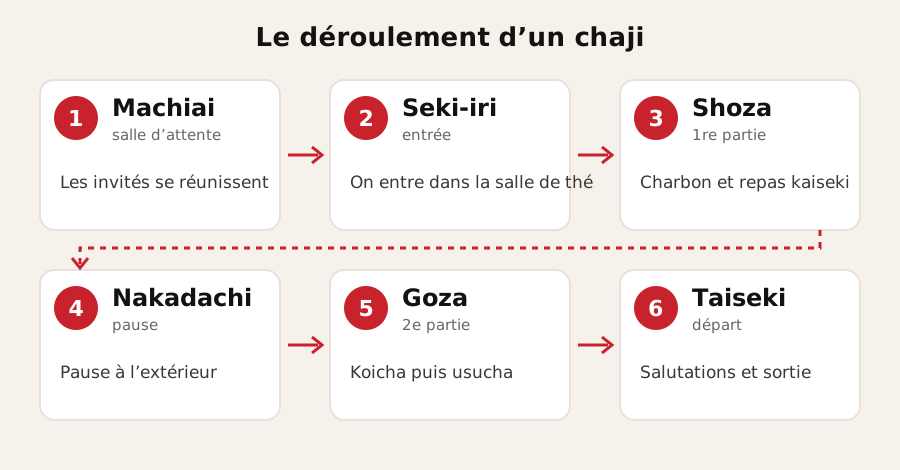
The “chaji” is a formal ceremony with kaiseki; it unfolds in this order: waiting room, entering the room, first part, break, second part, departure. The “chakai” (ōyose) is a simplified gathering for many guests, where koicha or usucha, one of the two, is usually served. “Wa kei sei jaku” is regarded as the fundamental motto of Rikyū’s school.
To experience in Bordeaux
In the events section of our site there is also a ceremony of about one hour, led by tea master Senkei Onishi, on 6 and 13 November at the tea shop “Maison Un air de thé” (33 rue Buhan). You taste Japanese sweets and prepare tea according to custom. Limited to 4 people per session, €55. Booking is required; check the latest announcement.
To keep in mind
Some dates are a matter of tradition (“it is told that”, “it is said that”). Gestures and the meaning of words vary with the school and the period. What is presented here remains very general. To really learn, follow the explanations of a master and their school.
Learn the grammar
French grammar
Learn sentence patterns and usage from the article’s own sentences.
01The present indicative
est / sont + attribute (noun, adjective, prepositional phrase)
La voie du thé (chanoyu, sadō ou chadō) est un art traditionnel japonais : on chauffe l’eau, on bat le thé en poudre (matcha) et on le sert aux invités.Key pointsÊtre in the present is est for a singular subject and sont for a plural one. It describes nature, state or place (“is”, “is located”). If what follows (the attribute) is a noun, adjective or prepositional phrase, it is not a passive. If a past participle follows, it is a passive (est annoncé). Headlines and summaries often use the present to describe the current situation.
02The passé composé
present of avoir + past participle
C’est Kobori Enshū qui parla de « voie du thé » ; le caractère « voie » (道) s’est alors diffusé, et dans la seconde moitié du XVIIe siècle on a aussi employé « 茶道 ».Key pointsThe passé composé is the most common past tense, used for “did” and “has done” — actions completed in the past. It is formed with the auxiliary avoir (a / ont…) in the present + a past participle. Past participles of -er verbs end in -é (annoncer → annoncé); learn the irregular ones (faire → fait, prendre → pris, voir → vu). In the negative, ne … pas wraps the auxiliary (n’a pas annoncé). In the news it reports facts that have already happened, such as “announced” or “voted”.
03The passé composé of pronominal verbs
se + present of être + past participle
À l’époque d’Edo, le système des maîtres héréditaires (iemoto) s’est organisé autour des trois maisons Sen.Key pointsThe passé composé of a pronominal verb (se + verb) always uses être as auxiliary (il s’est diffusé / elles se sont réunies). Se changes with the subject: me, te, se, nous, vous. The past participle usually agrees with the subject in gender and number.
04The imparfait
stem (nous form of the present) + -ais / -ait / -ions / -iez / -aient
Cet article retrace l’histoire, les écoles, les ustensiles et les types de réunions, en japonais et en français.Key pointsThe imparfait describes states, background, habits and actions in progress in the past (il était, elle avait, ils pensaient). Take the nous form of the present, drop -ons, and add -ais / -ais / -ait / -ions / -iez / -aient. If the passé composé gives “the event itself”, the imparfait paints “the situation at the time”.
05The present conditional
stem (infinitive) + -ais / -ait / -ions / -iez / -aient
Le 11e maître, Gengensai, aurait conçu à l’occasion de l’exposition de l’ère Meiji 5 (1872) le « ryūrei », service à une table, pour recevoir les étrangers.Key pointsThe conditional expresses possibility, supposition, unconfirmed information and polite requests (“would”, “might”). It uses the same stem as the future and the same endings as the imparfait (-ais, -ait, -ions, -iez, -aient): pouvoir → il pourrait. In the news it is used to avoid asserting, as in “is reported to…” or “there is a possibility…”.
06The passive voice in the present
être (est / sont) + past participle (+ par / de)
Le « koicha » (thé épais) est préparé avec beaucoup de matcha et peu d’eau : on le « malaxe ».Key pointsThe passive means “is done” or “is being done”. It is formed with être + past participle, which agrees with the subject in gender and number (la mesure est adoptée / les mesures sont adoptées). The agent is introduced by par (or de). In the news it is common when the event, rather than the actor, is the focus (est prévu / est annoncé / est connu).
07The passive in the passé composé
a / ont été + past participle
La Mushakōjisenke a été fondée par Ichiō Sōshu ; son nom vient de la rue Mushakōji, à Kyoto, où se trouve la maison du maître.Key pointsThe past passive means “was done”. Its form is present of avoir + été (past participle of être) + past participle. Été does not change, but the last participle agrees with the subject in gender and number (la loi a été votée / les textes ont été votés). It is frequent in news reporting results such as votes, decisions and announcements.
08The gerund
en + present participle (-ant)
Elle est née lorsque Sōtan, en prenant sa retraite, a cédé tous ses salons à son quatrième fils Sensō Sōshitsu.Key pointsThe gerund means “while doing”, “by doing” or “when doing”. Its form is en + present participle (-ant). Take the nous form of the present, drop -ons and add -ant (faire → faisant). The subject is normally that of the main clause. It shows things happening at the same time, or the means.
09The imperative
present vous form (-ez) / nous (-ons) / tu
La réservation est nécessaire ; vérifiez l’annonce la plus récente.Key pointsThe imperative expresses commands, requests and advice. It has no subject: the sentence starts with the verb (Consultez les informations.). The vous form ends in -ez, nous in -ons (Restons prudents.), and tu in -e for -er verbs (Consulte). It is very common in notices and warnings (Vérifiez, Consultez, Restez informé).
10Pronominal verbs
se / s’ + verb
Il ne s’agit pas seulement de boire du thé ; l’hôte et les invités partagent un moment où les cœurs se rencontrent.Key pointsA pronominal verb is used with a reflexive pronoun (me, te, se, nous, vous) before the verb. It can mean “do to oneself”, “be done” or “do to each other”. In the news, se traduire (to result in), se tenir (to take place), s’agir de (to be a matter of) and se diffuser (to spread) are frequent. The pronoun changes with the subject (il se tient / ils se tiennent / je me souviens).
11Negation and its scope
ne / n’ … pas · ne … plus
Il ne s’agit pas seulement de boire du thé ; l’hôte et les invités partagent un moment où les cœurs se rencontrent.Key pointsNormally ne and pas wrap the verb. Before a vowel, ne becomes n’. Check which part of the sentence the negation covers. Ne … plus means “no longer”.
12Citing a source with selon
selon + noun / organisation
On y goûte des pâtisseries japonaises et on prépare le thé selon les usages.Key pointsSelon means “according to”. Put a person or organisation after it as the source. It separates facts the writer checked directly from what another body or report said. Citing a source does not turn a forecast into an accomplished fact.
13Purpose with pour
pour + infinitive
Le 11e maître, Gengensai, aurait conçu à l’occasion de l’exposition de l’ère Meiji 5 (1872) le « ryūrei », service à une table, pour recevoir les étrangers.Key pointsThis is the purpose, “in order to…”. Put the base form of a verb after pour. The purpose stated here is separate from whether the effect was actually achieved.
14The construction il s’agit de
il s’agit de + noun / infinitive
Il ne s’agit pas seulement de boire du thé ; l’hôte et les invités partagent un moment où les cœurs se rencontrent.Key pointsIt explains what something is about: “it is a matter of…”. The il is not a particular man but a formal subject of this construction. The negative il ne s’agit pas de means “this is not about…”.
15The subject relative pronoun qui
noun + qui + verb
C’est Kobori Enshū qui parla de « voie du thé » ; le caractère « voie » (道) s’est alors diffusé, et dans la seconde moitié du XVIIe siècle on a aussi employé « 茶道 ».Key pointsQui continues a description of the person or thing just mentioned (“the one that does…”). Because qui is itself the subject of the next verb, do not repeat the subject. The verb agrees with the noun qui refers to.
Japanese grammar
Understand the structure and usage from the text.
01Cause or purpose with ため
〜ため / 〜ために
11代の玄々斎は、明治5年の博覧会で外国人を迎えるため、いすに座る「立礼(りゅうれい)式」を考えたとされます。Key pointsため is used for both reason and purpose. “成立ではないため” is a reason and “運転手を守るため” a purpose. Decide from the whole sentence whether what precedes is a cause or a goal.
02Giving examples with など
noun / expression + など
茶の湯(茶道)の歴史、三千家などの流派、濃茶と薄茶、道具、茶事と茶会のちがい。Key points“暴言など” gives “abusive language” as one example. It is not necessarily a closed list of only the things named. It also helps when reading the scope of a news story.
03The polite past ました
verb stem (連用形) + ました
もとは「茶湯(さのゆ、ちゃのゆ)」と呼ばれました。Key pointsIn “発表しました”, ました makes a verb polite past. The negative is “ませんでした”. Read the actual date together with the date and time in the text.
04Quoting with と: content and report
plain-form sentence + と + verbe de parole (報じる, 説明する…)
千利休は「数寄道(すきどう)」と呼んだと伝えられます。Key pointsと takes the content that is reported or explained. In “改定する方針だと報じました”, “改定する方針だ” is what the report said. Separating the content from who said it and how makes long sentences easier to read.
05Treating a clause like a noun with こと
plain-form sentence + こと + particle
「和敬清寂(わけいせいじゃく)」ということばが生まれたのも、この時代です。Key points“〜すること” treats an action or content like a noun. The particle after it (が・を・は…) shows its role in the sentence. “ことができる” is a fixed combination meaning “can”.
06Possibility in Japanese: できる・られる
verb potential form / 〜ことができる
ボルドーで体験できる茶会の情報もあります。Key pointsできる is the basic verb for ability. The potential form of 受ける is 受けられる. The same られる can also be passive or honorific, so decide from the meaning of the sentence.